
Memories of Uncle Ivan
In long hindsight now I can see Uncle Ivan was no ordinary human being or drinker – the Second World War and its ghastlinesses had changed him. My mother, Ivan’s sister often said he had come back much changed.
Strangely though, my young memory of him over 60 years ago was pleasing. He was a character, always happy to see me, full of ribald advice and jokes. My cousin Billy and I loved it. (See Billy’s memories of Uncle Ivan at the end of this piece.)
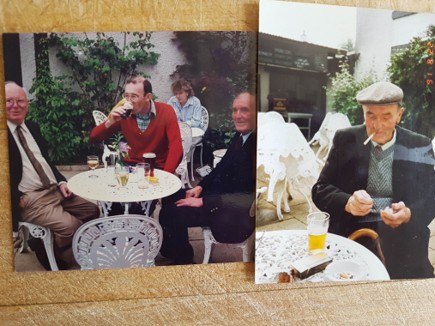
At some local Edinburgh pub. Visitor from New Zealand, me and Ivan.
Uncle Ivan’s life and ways would need more ability and clearer memories than I possess to do them justice. I wish I had more examples of his real life, background stuff, schooling, army life and general views of life. He was such a big character that the memories I have of what he said and did are only just enough for a haphazard portrait of sorts. Maybe the wishing now that I had more material stems from my adult perspective. I certainly never felt that I needed to bother when I saw him at the time in my teens and on isolated visits home to see my parents, my mother surely able to tell many tales.
Ivan John Atkinson, real name John but everyone called him Ivan. Where did that name come from? No idea. The grandfather was Irish, born in the town of Ballina, County Mayo, don’t know his first name. My mother often recalled as a child seeing him brought home dead lying on straw on a cart. There had been a cave-in at the mine, a pit prop had broken. Even sadder because it was his last day, his retirement day.
Ivan was born in and lived all his life in Uphall Station, a small mining village about 30 minutes drive from Edinburgh. Opposite their house was a huge forest that the family loved; all them were brought up in the tiny house consisting of living room with an open fire and a second room with a sink. Each room had bed recesses with big beds in them that you had to climb up a wee ladder to get into. They were later both taken out to create an alcove for a table and storage. Later they acquired two other bedrooms in an adjoining wee house.
In Uncle Ivan’s home, the sun shone in bright at the front door into a small vestibule or connecting hallway between the two wee houses and into the main room, a sharp turn right from the front door, just a step or two. When Uncle Ivan came home from his labours he blocked the sun for a moment in the doorway, his huge frame black against the light, his shoulders like hunched cliffs, but then his smile and bright eyes lit up on seeing me, a youngster. Always, “Ho, ho, ho, what a fine fellow – you’ve got taller since the last time. Let’s have a look at you, stand up straight, that’s it, ho, ho, ho! I think you’re going to be big and strong, able to look after yourself all right.”
Ivan was in Burma during the Second World War. He got home in 1945, at the age of about 27, to the house he was born in and was to live in until he died in the early 1990s. So he was with his parents, then when they died, he lived on with his sister, my Aunt Jo.
Mum told me that on his return he joined the family all right and everything was fine, but later grandma out of earshot of Uncle Ivan, asked if anyone else had noticed the weird wildness in his eyes, a look that wasn’t there when he left. Burma had been hideous, of course. There had been an episode where his captain, also a friend had had his head blown off and it had landed in Ivan’s lap. He never talked about it but there were shrieking nightmares. Mum said she used to go to him and stroke his brow and quiet him until he went back to sleep.
Mum always said we should have seen Uncle Ivan before the war, “Such a fine lad, what a waste!” She and grandpa also often said they wished he had been able to get psychiatric help when he got back. Seemingly it had been available but somehow he had missed out on having it or more likely, he had refused it, or maybe there was something to pay. If it cost anything they probably couldn’t afford it. Even if it had been free though, he wouldn’t have wanted to do it, seeing it as a weakness in seeking help of that kind.
I am not sure if he was stubborn and wayward by nature before the war but he certainly was very turbulent and wild in his ways after it. This manifested itself most clearly in the drinking. When he got home drunk there would be shouting, demanding and arguing. Mum said it was very difficult for everyone, especially for Jo who was so different in her love of language, reading, culture and travel in France, Italy and Greece.
He almost certainly had what is now called Post-Traumatic Stress Disorder. In those days it was called shell-shock.
The scenes in my memory of Uncle Ivan are like snapshots with a loud sound track. The clarity is to do with his impact as a person and the fact that I saw him only occasionally, possibly no more than three or four times a year.
Uncle Ivan possessed that most marvellous skill, the ability to transform the everyday into the characterful and intensely interesting. The way he expressed himself imbued his words with a golden glow of interest, such was the poetry and the energy in his language. Some called it booming, loud and invasive. However, to a young lads’ ears and eyes Uncle Ivan could lift the ordinary into new weird realms of excitement.
Ivan had a way of speaking that was characterful and colourful to put it in mild terms. Some would say it was loud. His sister often called him noisy and booming.
He was certainly opinionated and would often tell stories about people he had met at the pub and refer to them as fools.
“The man’s a fool!” or “What a fool!” or “He’s not quite right in the head, you know, something missing up there.”
Sometimes he’d say, “He should be locked up or done away with. The world would be a better place without the likes of him running around.”
Yet he had a way of saying it, a turn of phrase, a twinkle in the eye, that made even the most outrageous opinions sound like fun. He would throw his head back and laugh as he recalled what Jimmy or Bobby or Tam had said, then denounce them for not having a brain or being uneducated or even worse, not interesting. “The man thinks I’m interested in his family and his troubles. Well, I’ve got news for him. Someone should teach him about telling a story, about what really interests someone. Some people really are very stupid.”
For much more by me on Uncle Ivan, go to Fine Line Press website.
Memories of Uncle Ivan from Billy Atkinson, his nephew.
(Billy wrote as introduction: these are as told to me by Uncle Eric, Uncle Ivan’s much younger brother, a fount of graphic tales of derring-do.)
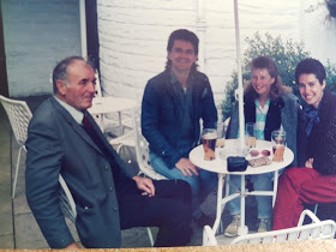
Uncle Ivan, nephew Billy, his girlfriend, Dorothy and my wife, Beth.
He recalled sitting one day in Atkinson Place, having some dinner with his mother and Ivan. Now, this must have been some time soon after the war, Ivan home, still a young man, raising a ruckus all around the neighbourhood. Eric must have been still a boy, in his teens certainly, keenly watching the world and its strange goings-on. They were sitting there at the table, by the fireside, when two rough looking characters burst unceremoniously through the door into the living room, looking for Ivan, no doubt to settle some score, probably to do with gambling or fighting. Eric said (words to this effect): “I never saw anyone move so swift and decisive. Ivan rose from his chair, no flicker of hesitation, and in one movement was straight upon the the two fellows, fists and feet flying, pummelling them on their retreating backs as they turned in the panic of sheer surprise, trying to make their way out the door they’d entered by seconds only before.”
Eric followed them out the door, the two hapless intruders stumbling in their haste to be gone and escape the rain of blows Ivan in his fury continued to deliver. Eric watched as his much older brother roared after them as they finally escaped down the hill: “Never, never, ever come back and dare to disturb my mother’s house, never again, you hear me!!”
That story always made me think of Long John Silver and RLS’s description of the swift, deadly violence meted out to an uncooperative shipmate, as witnessed by Jim Hawkins, in the clearing on the island, though in Ivan’s case he was only defending the sanctity of his mother’s house from boorish intrusion, not murdering an innocent.
Another story that Eric told was as a young lad (much like Jim Hawkins). Eric looked up to his older brother by a good 11 years, in many matters, not least in the fighting. So as a mid-teen, he asked him one day if he could give him some lessons in boxing, how to spar, feint, duck, that kind of thing. After some probably irritating nagging, Ivan agreed to get the old army gloves. I remember them, massive mittens which I could barely raise my arms with, never mind swing a punch. Ivan got his gloves laced up first and proceeded out the back door to the garden, followed directly by Eric. No sooner had the unsuspecting youngster stepped over the threshold than he was sent spinning to the ground by a mighty blow to the side of his head. Spluttering and dizzily staggering to his feet, Eric demanded an explanation, only to be told by Ivan: “Lesson number one, if you’re going to fight, do it directly, don’t telegraph your moves and always get the first punch in.” It was a lesson learned in Ivan’s school of hard knocks.
One more tale of swift, uncompromising violence. Eric and Ivan had been to a Hearts vs Hibs game at Tynecastle and were making their way, with various stops for refreshment, to the West End finally to catch the bus home. On Lothian Road they decided a pint at the Shakespeare (on the corner adjacent to the Usher Hall) would make a possible final port of call before the bus. Now, as Eric explained the Shakespeare had a reputation as a bit of a boozer for Hearts supporters at the time, probably because of some managerial influence. So when the two young men swung boldly into the bar, they were greeted by cold, unfriendly faces because Eric was wearing a Hibs rosette (no scarves in those days). “Yoose Hibs supporters, eh?” said the big red faced barman.
Eric, not averse to a bit of cheeky fun, piped up, in his best Paddy accent, “We’re Irish, if that’s what you mean.” The barman glared and commanded, “Beat it, the baith o’ yis! Git ootah ma pub!” Ivan said immediately to Eric, “Ok, let’s get out of here.” Eric, his Celtic blood up, was surprised and disappointed that his brother saw fit to back down to these galoots, but no choice except to do as he was bid. Outside, Ivan said to Eric, “Quick, in here!” It was the door to the snug, a tiny private room for couples. And in there, unhesitating, he rapped loudly on the hatch, connecting direct to the bar. As the barman opened the hatch door and stuck his head in the opening, Ivan already had his arm drawn back and quicker than you could follow let fly with his bunched fist walloping the barman’s big red Proddy face fair and square between the eyes. It was like an explosion, said Eric later. In seconds the two of them were careening and whooping down Lothian Road to the West End and the safety of the bus to Uphall Station.
“Let’s have a pint in our local Brock instead,” said Ivan.
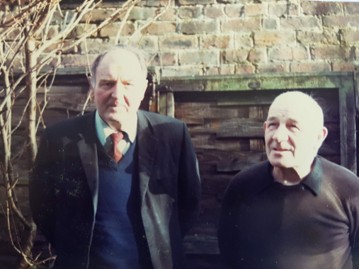
Uncle Ivan and my father.