
Long-Life Memories and Stellar Stories of Graham Bathgate
Introduction
I could have called this my autobiography but with the stories and since it’s a collection of my life activities in no order, I felt better to choose a more general title. Anyway, no-one would want to read an autobiography by me!
I have been a writer for over 70 years, mainly diary writing and recording interesting events and observations. I have also entered stories in many competitions, even already written a few for the collections I’ve published, such as “What Keeps Me Going”, “True Travel Tales” and “Forty Stories of Japan”. There are also whole collections of my writing about wine in “To Wine”; my friendship with a centenarian in “Poetry a Centenarian Remembers” and a hugely creative volume of “gushers” or people raving about themselves and their lives, both real people and imagined. There’s also a book of cat photos and my inventing what they would say in “CatSpeak”. That reminds me of numerous obituaries, mainly for dead beloved pets. Then there are the thousands of letters sent in and from the seven countries I’ve lived in. I have a huge collection of letters to the media, mainly making corrections and giving suggestions for improvements.
You’ll find various topics here covering my travels; my early and later life; teaching experiences; views on all kinds of topics (mercifully mostly short!); a couple of children’s stories; lots of experiences of living in Japan; crossing the USA by Greyhound bus; imagined conversations with my doctor; people “gushing” forth their personal thoughts and feelings; writings on Scotland, New Zealand, France and Japan, and a selection of Stories for Competitions. There are also several lengthy pieces on the likes of Addictions, Cemeteries, Expressway Taking our Home, Loneliness, Scots Language, Uncle Ivan, Favourite Elvis Songs, Health and Broken Bones, my Wife’s Recovery from Brain Surgery, and Robert Louis Stevenson.
It’s an eclectic collection, written and compiled for everyone to find something that appeals to them.
In future there will be separate collections on death and grief, on a weird and wildly imaginative street dog in Tokyo, on cemeteries I have loved, and maybe a separate volume on my travels.
I would like to acknowledge my mother who taught me for my first four years of education in her one-teacher or sole-charge school. She encouraged me to write.
I hope you enjoy reading some of this as much as I derived pleasure from expressing myself in heaps of stories and views. I’m sure you’d like to know if I have favourites. That’s easy: “Lads and Ladies in Paris, 1963”; “Lucky Cat in Japan”; “Pick-up in a Paris Street”; “Oh, Lonesome Me!”; “Uncle Ivan”; “Montparnasse Cemetery”; “Aoyama Cemetery”, “The Wine Lover and the Wowser” and “Wine Village Vignettes”.
Good luck!
Chapter One: Early Life
A Lucky Life
July 17 ‘05
When I recall my life now over half a century gone, I find it fits neatly into stages and each period is imbued with great happiness and good fortune. Of course, the tapestry has some torn threads but standing back from it I see a fine picture.
I was lucky in terms of having happy and kind parents who believed in the simple things of life. I was born in Orkney, the islands north of Scotland and south of the Shetlands. I lived there for nearly four years on a croft of which my most vivid memories are of howling winds, great expanses of heather, dad’s cows in the byre just off the kitchen, dad’s sheepdog Old Jim from his home farm south of Edinburgh, sliding down the red door taken off its hinges and propped against the table, dad’s ready laugh and my mother’s smile. I also recall moments of six weeks in hospital with a broken femur incurred when I ran through “the windy gap” to greet the grocer’s van. I was almost three and wasn’t talking. I can remember lying in Balfour Hospital, Kirkwall, looking at my leg in plaster all strung up. When I came out of hospital I was able to talk (and walk!). I still have a shiny bit on my ankle where the plaster rubbed.
I have been lucky in this life in terms of strong desires and needs. The strongest urge has been to travel and I have surely satisfied that, and in retrospect fairly easily, although there have been lonely times, one of the worst leaving the Atkinsons’ ranch where I stayed a week near Rockport, Indiana on my way across the USA by Greyhound bus (The cost was 99 dollars for 99 days). After a great week of fun with the family of teens a bit younger than me although I think the oldest was only a year younger, I headed off again to St Louis and it was very lonely that night in my hotel room. I wrote a letter of thanks to the family, and somehow they wrote to me, maybe in Vancouver (I’d given a forwarding address), and invited me to come and stay again on my return, which I happily did for a few days. It was easier leaving them the second time as I was on the last leg of my American trip and heading for home.
The next piece of great fortune has been the desire for friendship and partnership, and in that I have been blessed with amazing friends both interesting and generous. My greatest friend, my partner, has never ceased to surprise me insofar as she has put up with my eccentricity and cantankerous nature (Needing to move on, needing to find out more and needing to have situations my own way don’t make for easy living for someone else). She gives me joy in my every thought, especially on my travels.
The third piece of good luck is physical. I was born active. I climbed trees, ran and did sports (football in winter, cricket in summer) for nearly 18 years in the country areas of Aberdeenshire and Perthshire where we lived in Scotland. I look back on a life of great mobility involving walking, running, cycling, swimming and going quickly from place to place – I cycled over two miles a day to catch the bus to Perth Academy, and of course cycled home again.
The fourth is academic or scholastic. I had a happy education. I went to kindergarten in the south of England, a tiny village kindy in Baughurst, Hampshire. From the age of five, my mother taught me for four years in her one-teacher school in Aberdeenshire, then I had a great year with a male teacher in Vancouver in 1957-58; after that it was Scottish schools from age 11 to 18, then Edinburgh University and Herriot-Watt University. However, I like to think that I learned much more after I left these formal exam-oriented institutions and moved to New Zealand where I was lucky to find myself in a teaching environment learning to teach on the job as I taught. I worked hard at that for several years after I had gained a Distinction in the Teaching Diploma from Christchurch Training College. I also did several certificate courses in classroom teaching and speech&drama as part of helping me to teach better. Then there was an interest in teaching English as a second language. That was once a week as part of my Polytechnic teaching, classes of immigrants – I recall there were nine different languages in one class! For sure that work made it easier a few years later moving to Tokyo to understand the difficulties of Japanese students, just one common first language in the classes of company workers, school children and general conversation students at the school we worked at.
In 1981, I taught for a year at TAFE, one of many Australian technical and further education colleges. That was in Mackay, north Queensland, a good year allowing my partner to visit, also my parents. I managed to visit friends in Melbourne and Brisbane, also getting to three islands in the Whitsundays.
From 1982, the Tokyo teaching was wonderful insofar as the classes were small (usually no more than eight, although I have vivid memories of a “class” of over 100 hotel workers once), and the classes consisted mostly of adults, many of them able to speak English correctly, just needing help with fluent expression and vocabulary. From Japan we travelled extensively in East Asia, including to China, Malaysia, The Philippines, Korea, Thailand and several times to Hong Kong. When my parents were alive, we went to Edinburgh each summer and enjoyed the international annual festival there. We went to New Zealand and Australia every Christmas. We counted ourselves so very lucky to be able to do that, and it was much enjoyed.
After ten years in Tokyo we needed a change and went to France thinking that we would easily get English teaching work. This was not the case, the French still not into bothering about improving their English speaking. We managed to buy a house in a small wine village in the Languedoc, and have had the pleasure of going there many times since. Also it has been wonderful letting other people be there to savour the delights of French village life.
We returned for good to NZ in 2002, but went travelling in Europe for several months
before buying a big property on the Kapiti Coast, north of Wellington. We kept hens and had cats – several flocks of wild ducks flew in each day. It was paradise and we would probably still have been there but for the government deciding to put an expressway through our land – we were informed of this in 2010. I asked the manager from NZTA dealing with relocations for three springtimes before moving. We got them and we moved to a big more modern house in December, 2013.
This new place was wonderful with country views, hardly any traffic passing, good walks, loads of nature – again we kept hens! I started going to the new aquatic centre to swim and have a spa at least four times a week.
It has been a lucky and interesting life.
Memories of Childhood / My Life
“Get Back!” and “I Believe in Yesterday”
Introduction
The following are memories of ordinary things that happened to me long ago, some of them extraordinary and some of them more like simple stories, funny and interesting I hope. The great thing is I can remember them and make something of them, add some information to them, do some research, reach in and weave something more readable into them.
I recall Marshall McLuhan, the Canadian philosopher and media theorist saying maybe in the 1960s that the medium is the message – the way a message is delivered affects the content we understand, whether by reading, listening, watching a video and so on. His book was called “The Medium is the Massage: An Inventory of Effects”.
Someone said that the Beatles could have recorded the phone book and it would have been a hit, such was their kudos. I’m not in that league but I hope my message is clear: real experience rewritten and enhanced somewhat with a dash of good description and creativity.
My Parents’ Honeymoon – from Doctor Dialogues, my imagined conversations with equally imaginary doctor. I put this into “My Friend Archibald”.
Doc: Do you know anything about your parents before you were born?
Gee: That’s a strange question but a good one because it brings up a memory of something oft told by my mother. She loved a good story, preferably a bit outré if you know what I mean, even if it cast her and others in an eccentric light.
Their honeymoon was to the Orkney Islands in 1947, at the beginning of August, and I was born end of April, 1948. Ah hah, now here’s the real story: they travelled by train to the northern tip of Scotland, John O’Groats to get the ferry boat to Orkney, then on to another island, Stronsay by a smaller boat.
On the way, my father noticed that he didn’t have his suitcase, he’d left it on the big ferry or on the quay or something. Anyway, it wasn’t the clothes that were important, it was the bottle of whisky in it. Oh, dear! I think they were either able to go back and retrieve the suitcase or maybe get another bottle somewhere – on Orkney probably not difficult. The important thing was the whisky had to be replaced. I don’t know about the clothes. Although my mother was born into poverty and had to strive all her young life to get a good job, but my father wasn’t short of a penny; he had received a cash share of the family lime-burning business, a pay-off as he called it. In later years he would come to see it as a trick by businessman brother Rob to get rid of the eight siblings, leaving him as sole owner of the business, still going to this day.
Doc: Well, that’s a classic! I really like how the whisky was an absolute necessity, the going back to retrieve it would have been something not done for pajamas!
Gee: I don’t think pajamas were invented then … certainly not clothing that my father ever knew, his preference being a bed shirt, or nothing at all. Imagine wearing nothing to bed in cold sheets in freezing winter Scotland! Things were very different back then. I remember years later though when my parents got an electric blanket because they moved to a house with electricity.
Doc: I just had a thought about the whisky bottle – it was a case of whisky!
Gee: Oh, very funny! Yeh, in the case of whisky my father simply had to have some! No,it was really just the one bottle of whisky.
**********
My Mum’s Ways
Not a kitchen person, my mum, she hated all housework. I often said to her later in life that she could afford a home helper now, why not get someone to do the drudge work even just a couple of times a week. She was too proud to do that. In fact, in her 80s she said when she couldn’t do her own housework like sweeping and dusting, she would shuffle off.
I recall the time she bought a pressure cooker. “That’ll save a lot of time!” The only thing that mattered in her kitchen. She would rustle up mince and tatties, fish (always sole in milk) or Canadian shortbread as a treat, all at lightning speed so she could go have a cigarette while reading “The Scotsman”, her relaxation after teaching all day.
My Father
I well mind the time he asked Sir Robin Philipson’s wife, aged in her late 40s with her new baby. “Whaur did ye get that from?” She politely said, “Oh, Mr Bathgate, she’s mine, Robin’s and mine.”
Then there was the time I went with him to a garden and an Asian looking man came to the door. “Whaur aboot in China are you from?” Oops! I think he said he was from Korea or maybe HK. Risky question though.
I once took dad in his early 70s to the doctor about some mild malady (He seldom had anything wrong with him). The youngish doctor asked him if he smoked.” My father tried to flag away the question, so I said, “About 15 a day.” Then the question, “Do you drink?” Again my father tried to dissemble, so I said, “About half a dozen good whiskies a day.” The doctor
then said, “Carry on!”. Dad would say after that, “What a great doctor!”
Odd Quirky in my Life – experiences for living, for experience
I had a good time growing up as a teen in the 1960s, especially getting to know The Beatles and The Rolling Stones. Looks such as longish hair were more important than how the body was.
I did secondary school at Perth Academy, the top ranking school among several in Perth, the others catering for those who scored lower in the all-important “11-plus Exam”. Some teachers were OK but in professional hindsight now, many of them were useless, probably hired because of their academic prowess. Some of them would challenge you astutely with “What are you thinking? What do you have to say?”
There was awful practice dancing in Physical Education classes in preparation for the end of term Christmas dances at school. We joined classes with the girls, and it was excruciating having to choose a partner. But
great not having to change into gear for exercising.
My Edinburgh University life was remarkable for the freedom to go to the likes of Sandy Bells pub (managed to drink 14 Holsten lagers one night (and walk home!), to have conversations with older adults, to go for great walks in the parks like The Meadows and up Arthur’s Seat hill, and to enjoy the freedom of flatting with a few others.
At the end of first year at university I crossed the USA by Greyhound and back again. (See “Across the USA by Greyhound” in this book.)
Before I left Edinburgh for New Zealand I went to see Robert Louis Stevenson’s house where he was born; it was up for sale in 1970. (See in this book “Memories of Robert Louis Stevenson in Doctor Dialogues”.)
*********
Guildie Howes, a big home farm, dad’s birthplace and workplace for nearly 40 years
I recall one odd time at Guildie Howes. It was maybe the summer of 1956 when I was just eight years old. I was with dad who was helping at the lime kilns next to his farm – that was a factory making lime for fertiliser. It was a big business started by his father W.T. Bathgate. You can still see lorries in the Edinburgh region with that name on. Anyway, the men were working or chatting or something at the kilns and dad asked, more like told me to go along to the village to get a can of beer – not like today’s cans but one he gave me, like a milk churn, a mini one all silver with a special lid and a wire handle. I wasn’t at all happy to do it and can recall expressing reluctance because I knew it was a distance, probably nearly a kilometre, so the whole journey was getting on for a one and a half miles.
I suggested to dad that he shout to the village, the same way his father used to do, but predictably he didn’t care for that idea, although he possessed quite a powerful shout, but maybe not as stentorian as his father’s. The going there was fine swinging the can around, no weight to carry. I don’t recall the interaction with the barman but I do remember that it was easy enough to get the can filled and pay nothing because it would be settled later, as they knew and trusted my dad.
Going back was not so pleasant because the can containing maybe half a gallon of beer was heavy – yes, it would have been that amount – so I did my best to run along without spilling any to get the beer back to the thirsty workers.
Amazing how I didn’t complain more about having to do it because there was nothing in it for me that I remember … unless maybe there was a sixpence, the standard payment back then for a favour.
Years later I recall reading about the life of Jack London, and he had to do something similar except that he drank the contents. I don’t think that occurred to me, not wanting to disappoint the men.
My Early Years
My childhood images are clear and abiding: winter was tons of snow, warm coal fires inside. I would look out my bedroom window at the driving snow, thinking perhaps no school today although for me it was just round the corner, my mother having the one-teacher country school there. I would watch for the snowplough to clear the roads full of snow drifts, perhaps allowing the other children to come to school from afar.
School lunch in very cold winters was huge silver canisters of hot food, Mrs Getty serving mince and tatties, cabbage, steam pudding and custard.
Summer was green, lots of whins, yellow flowers, the haunting sound of peewits. The rattle of whin pods in the wind, the popping of them in the occasional warmth.
There were walks in countryside, nature rambles we called them. I would marvel at the “singing” of the telephone wires, a mysterious plaintive humming. I always thought it was somebody speaking on the line.
I recall lying in bed early evening, unable to sleep especially in summer when it didn’t get dark until 11.00. Occasionally my dark forebodings would become too great and I’d call for mum who would always come and reassure me, and stay until I went to sleep. Perhaps repeating my earlier prayer on going to bed. “If I should die before I wake up / I ask the Lord my soul to take.”
As I said, my parents had gone to the Orkney Islands way up north off the coast of Scotland. That was on their honeymoon, and they had liked it so much that they bought a croft with the money my father received as his buyout share from the family’s big lime kiln business, W.T. Bathgate. So at the end of April, I was born exactly nine months after their marriage, and I was christened in St Magnus Cathedral in Kirkwall on the Mainland, the largest island in Orkney.
I had no idea that I would go on to regale people with telling the story of my uncommon beginnings. Actually, I was probably lucky to be born because my mother later said she never really wanted or needed to have family, her work as a teacher quite enough to fulfill and thrill her. Be that as it may, I couldn’t have had more loving parents in the hills behind Finstown between Kirkwall and Stromness until I was nearly four by which time I had just started to speak because I had six weeks in hospital with a broken leg at the age of three and a half, before which age I wasn’t speaking. We put it down to the quiet and the remoteness and the fact that my father, silently working the croft, looked after me while my mother was teaching. She had had to go back to work soon after I was born because my father’s sow had rolled on the pigs and killed the future earnings. Not speaking probably helped me to have clear memories from early on and recording them here!
Luckily perhaps I have very little memory of an earlier hospitalisation. We had to take a plane to the hospital maybe in Aberdeen, there again maybe it was a special ward at Edinburgh Royal Infirmary. Anyway, it was for an abscess in my ear, a life-saving or at least hearing-saving flight. That was the first hospitalisation in a life of about eight such necessities.
We had an old sheepdog, “Old Jim”, my father’s dog from his home farm,
brought with us to see out his days on the croft. My mother often recounted the amazing thing about Old Jim, which was that he could put on a show of smiling, rolling back his mouth to reveal his teeth, just like a person laughing. It’s remarkable that many years later, about 40, when I took my mother back to Orkney, we visited the croft of my babyhood, and my father’s tractor was still there all broken down and rusted, but my mother touched it with reverence.
We would visit mum’s parents annually, and they would come and stay with us, one at a time, always needing one to stay home to cook Uncle Ivan’s dinner, and to look after him in his shell shocked condition after the War. Funny the things I recall when I visited. “You’ll get it at Johnny Marr’s” was one of many lines. I can remember going there as a child on visits. It was about five minutes walk in Uphall Station, down the hill past other miners’ houses in the miners’ row, up a slight rise, then on the corner just before the railway station was Johnny Marr’s wee shop. This was pre-Beacham days! (Beacham closed hundreds of small stations in the late 1960s, many of which have been re-opened). It was a tiny dim-lit shop and Johnny was seated on high behind a dark-brown heavy wooden counter which lifted on hinges if he wanted to join the customers to get something. Not that he did that much because he seemed to be an invalid.
In my childhood, I had no idea that I was living in a time or environment that would become very past, almost a bygone era looking back on it. Vans used to deliver the various necessities like bread, groceries and meat. We had a car, so were able to go to the town of Huntly about five miles away, always a treat of a trip. I loved the newsagent shop with loads of toys. If it was just my father driving he always stopped at a pub on the outskirts of town to run in for a whisky and run back out again. Meantime, for five minutes I happily nibbled on a bar of chocolate, usually a Mars Bar or a Bounty.
I had to have a piece of apple before bed for my teeth! I also had to have a bit of orange or juice every morning because “It’s very good for you” my mother would assure me. My childhood health was paramount! So much so
that I wasn’t allowed to eat between meals, I suppose for fear that we would run out of food, not a great thing to do so far from town.
Living in the Braes of Gartly, the hills of Gartly when I was maybe about seven or eight years old, I remember sharply the winter snows, the tiny living room and the fire blazing. Dad would say let’s have toast and sardines, and he’d make it, the most delicious thing hot buttered toast and sardines and a cuppa tea with the wind howling outside and we’re all safe and comfy inside.
There were nature rambles with mum telling us, “Oh, look at that!”, perhaps some insect, a leaf or a flower. And there was chasing the hares across the fields. I remember often lying on the broad back of the land looking at the huge sky, clouds scudding. There was the smell of dark brown soil, and stones in the burns. I can still now see my shadow, when out walking in the hills. There were favourite paths for runs, and trees to climb, each with its special feeling and foot-hand holds. There was a field of grass beyond our garden, over the road. You could shortcut over to the Grants’ farm that way. There were dry stone dykes, old Prefect and Morris cars, and huge winter blizzards. The seasons were all clearly defined.
And there were many sums and grammar for homework in large workbooks. There was a big black metal guard round the big schoolroom fire. With a knife we sharpened our pencils into the coal skuttle. I also recall sharply making side to side movements during the Lord’s Prayer watching the whorl in the glass of the book cupboard behind mum – the blemish in the glass would move with my movement.
We had a huge wireless with its half dozen glass valves ensuring I could listen to Children’s Favourites on a Saturday morning. We had cats: Honey from kittenhood and Whitey, brought to us with her leg caught in a trap. Dad had to free it and the vet amputated it. She lived a good life thereafter, limping around.
There were school parties with streamers. I would wear my favourite jersey with coloured zigzag designs. Comics like the Beano, Dandy and Topper were much looked forward to. I regularly got The Robin, a weekly magazine for younger readers. Then the more expensive ones, pictorial stories of classic novels for one and thruppence.
Going to the pictures with dad was special. He would buy us tuppence worth of chips afterwards. There were piano lessons with Mr Center and my sheet music bag with its silver rod holding the flap for opening. There’s a clear memory of lying in bed upstairs, the small bay window up behind my bed. I would hear a car coming at night, the lights showing on wallpaper and moving across and down and away as the car passed. I’d look at the patterns in the same wallpaper and imagine seeing images of creatures.
I remember the English spoken in Aberdeenshire, the Doric like no other language, as it was mixed with English and a strange pronunciation. Possibly the best example I ever heard was when we were outside doing “art work” on huge sheets of off-white paper on big trestle tables, and a tradesman working on something at the school came up, looked at the painting of one pupil, and said, “Sic a sass yer makin’ ’ere, laddie!” or in English, “Such a mess you’re making there, my boy!”
It was interesting that my parents were both working, way ahead of their times. We were lucky with the two incomes. Dad would have got about five pounds for a five-and-a-half-day week as a forestry worker (Eight or nine years later I was earning around eight pounds for five days work a week at gravedigging) – no inflation in those days! Mum was on a salary as teacher, earning a bit more. I recall maybe around 450 pounds a year, or over nine pounds a week.
The great thing though was the solitude. We lived alone, no near neighbours, no hassles, responsible only for ourselves and dad’s pigs and geese. It was a wonderful way to live, but maybe not the kind of alone life many people would relish. Perhaps there were ways to handle it: I remember as a child always wishing for the future, longing for something promised, something to go to, be it a visit to the pictures or a drive or someone coming to visit; it could have been the promise of a picnic, a visit to the beach, going on the train, a comic arriving with the next episode of a story. Mum must have encouraged that way of looking forward possibly to cheer me up in sad moments, no siblings to play with and no near neighbours. In fact, I recall her often saying, “What shall we do now?” or “Soon we’ll be going somewhere” or “Something enjoyable is going to happen.”
My mother wanted the best for me, wanted me to do well in life, so she was a great encourager and pusher, trying to get me to do more, to try harder with “You can do it!”, “You just have to apply yourself”, and “You’ll need to buck up your ideas, my lad!” and then when she wasn’t getting the desired response, “You don’t want to be a plumber, do you?” And I’d say in disgruntled defence, her brother, my Uncle Eric was a glazier and her other brothers were tradesmen! She’d say that long ago they didn’t have the same education chances, her youngest brother Eric could have done better, given the opportunity. I’d suggest that maybe Uncle Eric chose his work. And then I’d ask how she and her sister managed to become teachers.
I had a driven education: I had to learn, no quarter given, homework had to be done; I was expected to do well in my school days. My mother watched my every move, expecting me to read, write, count and spell very well!
And she’d trot out the tradesman line again: “You’re not going to be an electrician or a carpenter, are you?” And I would say that I wouldn’t mind that kind of work, just to annoy her.
My Lucky Life
When I recall my life now well over 70 years of it, I find it fits neatly into stages and each period is imbued with happiness and fortune. Of course, the tapestry has some torn threads but standing back from it I see a fine picture which I greatly appreciate.
I was lucky being brought up by happy and kind parents who believed in the simple things of life. I lived for nearly four years on a croft of which my most vivid memories were howling winds, great expanses of heather, dad’s cows in the byre just off the kitchen, Old Jim the sheepdog from Dad’s home farm, sliding down the red door taken off its hinges and propped against the table, dad’s ready laugh and my mother’s smile. I also recall moments of six weeks in hospital with a broken femur incurred when I ran through “the windy gap” between buildings to greet the grocer’s van. I was almost three and wasn’t talking. I can remember lying in Balfour Hospital, Kirkwall, looking at my leg in plaster all strung up. When I came out of hospital I was able to talk, and 75 years on I still have a shiny bit on my ankle where the plaster rubbed … and I still do some talking!
I have been lucky in this life in terms of strong desires and needs. The strongest urge has been to travel and I have surely satisfied that. In retrospect I achieved it fairly easily, including Canada when I was nine – crossing on The Empress of Britain, giving me an abiding memory of playing the piano in a ship’s concert, at my mother’s urging of course – then from Montreal to Vancouver on the Canadian Pacific Railway; a year later my mother and I crossed the US by Greyhound bus from Vancouver; then I returned to the USA in 1967, travelling east to west and back again by bus, the cost only 99 dollars for 99 days – I managed seven weeks but it was still well worth it. (“Across the USA by Greyhound”)
I remember well it was the Summer of Love, especially in the likes of San Francisco with its Haight Ashbury, where all kinds of hippies and some famous people lived. I also went to a city on the east side of San Francisco Bay, called Oakland, to see where Jack London lived and became an oyster pirate in his teens. The bar there, “Heinold’s First and Last Chance Saloon”, was frequented by Jack London. He got many ideas for his writings in those early years. The bar still has the original glassware and mahogany bar!
There was France several times with my parents, also Ireland and England. Then with my mother and cousin Billy to Paris (See “Doctor Dialogue – Paris, 1962”), and on my own in my teens. I went with a close friend to Greece two times, giving me an abiding memory of sleeping in a cave on Santorini, the volcanic island (See “Greek Diary” and “Blood Money, Blood Oath!”).
Then I headed to New Zealand for teaching work for 10 years; next to Mackay in Queensland, Australia for a year – that move involved leaving a good Polytechnic job for the adventure of something very different in TAFE (Technical and Further Education) before going to Japan and teaching in Tokyo for 20 years. The over-riding feeling looking back on it all is very happy, and a sense of achievement, especially managing to live in all these countries and learn their ways, make friends, be part of the culture (well, maybe not Japan!), taking each place into my heart. Of course there were tough times, especially travelling alone, although I now do that easily, possibly having had loads of practice.
One of my most abiding memories of five years in Aberdeenshire was each winter the country road would be blocked. Eventually, the snowplough (or “snawploo” in Scots!) would come to open the road, throwing up 10-foot high walls of snow from the deep drifts. During this time, I can recall clearly as a young boy, maybe six or seven years old, often looking up at the tops of the walls, and of course trying to climb up.
I also looked often at a postcard album (I still have it) that my mother had created. It had hard embossed covers, deep crimson coloured, and was long rather than tall. The pages were jet black, the cards inside were black and white or in muted colours. They were held on the pages by special stick-ons that you inserted the corners of the cards into. The album was a record of my mother’s exchanging teaching year in Los Angeles one year before I was born.
I looked at this album because it showed me another place, a person I loved in her other life before my life. But mainly I remember it as another place full of exotic things far from life in the north-east of Scotland, a cold hard country without palm trees, orange groves, big cars, white houses, women in light suits and wide-brimmed hats, and other beautiful things.
I think this photo album sparked my imagination and gave me a desire to travel a lot and live in seven different countries. There are other reasons, of course. My mother used to say to me there was more to life than what I had as a child. She would say that I could go to other countries and see different things. I think that her abiding belief in life was the value of travel. My happiest memories of her are when I consider the joy she showed when she recalled her travels.
My mother applied for exchange teaching in Canada and landed a fine posting at Maple Grove School in Kerrisdale, an apple and peach blossom suburb of Vancouver. So at the age of nine, I went from remote hill country, gas tilly lamps, grocer’s and butcher’s vans, from gorse, burns, peewits and snow-blocked roads, to maple-leafy streets, shiny supermarkets, an open-air swimming pool, cars like floats, to electricity and television; from one-teacher schooling in a single classroom of a dozen pupils forming six classes of different ages, to a 500-pupil elementary school with many teachers. From the Braes of Gartly and awful winters, to Vancouver’s milder climate, living in a plush residential area. It had a softer climate with parks and boulevards, shops full of enticing goods, a cinema and colonial houses with unfenced lawns stretching out to the sidewalks and then more grass and trees bordering the streets. After serving her year as an exchange teacher, mum and I went back to braes, to wild and open fields, heathery hills all around and in January and February always getting snowed in.
My father had acquired a good job at the local Kerrisdale icerink driving the ice tractor, called a Zamboni. He stayed on for a further two years to help us with savings and the ability to have good holidays and a couple of cars – we even bought a television on which I eagerly watched the first Beatles and Stones on programmes such as “Ready Steady Go”.
My education before Vancouver in 1957 was at a village kindergarten in Hampshire, south of England and then five years of my mother’s one-teacher school in the wild braes of Aberdeenshire. Ten years before, a year before I was born, mum had spent an exchange-teaching year in Los Angeles loving the sunshine, oranges and rich ambience, a far cry from her near-poverty upbringing in a miner’s row with five siblings, south of Edinburgh. As if to confirm her father’s words – “Aye, with you the grass is aye greener on the other side.”
My mother was pleased that I would have a different teacher to her in Vancouver, and it was a man! This was in stark contrast to her teaching me for so long. One amazing thing about the house whose basement flat we lived in, it had three televisions. In Aberdeenshire we couldn’t have TV because we didn’t have electricity.
My Uncle Charlie and family, including my cousin Billy to whom I am still close, visited the Braes schoolhouse in July for their usual two weeks holiday while we were well on our way to Vancouver.
The next piece of great fortune has been the desire for friendship and partnership, and in that I have been blessed with amazing friends both interesting and generous. My greatest friend, my partner, has never ceased to surprise me insofar as she has put up with my eccentricity and cantankerous nature (Needing to move on, needing to find out more and needing to have some situations my own way don’t make for easy living with). She gives me joy in my every thought, as my friend and supporter on life’s journey and my partner on trips to many countries. When she prefers to stay home she always gives me a beautiful card with thoughts of safe travel written in a lyrical style.
The third piece of luck in my life is physical. I was born active. I climbed trees, ran and did sports (football in winter, cricket in summer) for nearly 18 years in the country areas we lived in. I look back with pleasure on a life of great mobility involving walking, running, cycling, swimming and going quickly from place to place.
The fourth is academic or scholastic. I had a happy education. I went to kindergarten in the tiny village of Baughurst in the south of England– it’s all built over now, so I was lucky to know an old English village before modernity struck, especially the long green or park in front of our cottage. I remember the locals playing cricket. From the age of five, my mother taught me for four years in her one-teacher school in the hills of Aberdeenshire in North-east Scotland, then I had a great year with my first male teacher in Vancouver in 1957-58; after that it was several Scottish schools from age 11 to 18, then Edinburgh University and Herriot-Watt University. One of the best experiences I had in Edinburgh was going to see Robert Louis Stevenson’s house where he was born – it was up for sale in 1970. (For more on this, go to “Stories for Competitions” and look for “Getting Closer to RLS”).
I think that I learned much more after I left the formal exam-oriented institutions in Edinburgh, and moved to New Zealand where I was lucky to find myself in a teaching environment, having to learn as much as I taught; I worked very hard at that for several years after I had gained a Distinction in the Teaching Diploma from Christchurch Training College. I also did several certificate courses in Classroom Teaching and Speech & Drama as part of helping me to teach better. I did another diploma in Teaching English as a Second Language.
Something that I took up at Training College, which helped me greatly in my teaching life was stage acting. I didn’t think I could do it but I persevered with a number of amateur productions and also a semi-pro music hall troupe with whom I performed in their melodrama. I continued the theatre interest by directing several plays. It was all great fun.
Then there was teaching English as a second language. Once a week as part of my varied Polytechnic teaching I taught a class of immigrants – I recall there were nine different languages! How much easier it was to understand and cater for the needs and difficulties of Japanese students in Tokyo, just one common first language. I did a Diploma in TESL (Teaching English as a Second Language) before going to Japan, then I did further study there for another qualification in teaching English.
Among numerous wondrous experiences of teaching thousands of Japanese businessmen, one stands out: I helped almost over 100 new employees at the Imperial Hotel to practise speaking to each other – all at once in a huge room in the basement of the hotel (See “Japan” stories).
My mother once said to me: “Please may I not become like my mother.” I can’t imagine why because Grandma was the gentlest kindest person. Perhaps it was in her 70s when she became huncbed and slow. To my eternal regret, I once said to my mother I did not want to be like her. Funny how things that go around come around. Was I simply repeating or saying something more sinister? To my mother’s credit I doubt if she would ever have said anything like that directly to her dear mother.
My mum was not a kitchen person and she hated all housework. I often said to her as she aged you can afford a home helper now, why don’t you get someone to do the drudge work even just a couple of times a week? She was too proud to do that. I recall when she bought a pressure cooker saying, “That’ll save time.” That was the only thing that mattered in her kitchen, getting out of it quickly. She would rustle up mince and tatties, fish (always sole in milk) or Canadian shortbread as a treat, all done at lightning speed so she could go and have a cigarette while reading “The Scotsman” or a good book, needing to relax after teaching all day.
My father had a way of expressing whatever came to mind, and it could appall my mother who would say afterwards, “Oh Graham! I didn’t know where to put myself!” I well mind the time my father speaking to the wife of Sir Robin Philipson, a renowned Scottish artist. She was easily 20 years younger in her late 40s with her new baby. My father asked her, “Whaur’d ye get that frae?” And she said, “Oh, Mr Bathgate, she’s mine, Robin’s and mine.”
There was a time I went with dad to a garden he was going to look after and an Asian looking man came to the door. Dad said to him, “Whaur aboot in China are you from?” Oops! I think he said he was from Korea or maybe Hong Kong. A risky question indeed!
My father could say a lot worse, much to my mother’s embarrassment. I remember one time he saw the neighbour Miss Burrell whose father was William Burrell. He had a whole Glasgow museum dedicated to his life and art collection. I think she was at the opening of her father’s gallery.
I recall that one of Miss Burrell’s great stories was remembering how as a child she would bounce up and down on a huge pile of Persian rugs.
Her flat was up a long flight of stairs in a terraced row of Edwardian houses in south Edinburgh, each with a basement (for the servants long ago) and two upper floors with large bay windows. My parents lived in a converted basement, the great advantage of such being access to a garden at the back. They would see Miss Burrell from time to time either going out or returning. She always had a cheery smile and would give a wave with a gloved hand. My mother would greet her warmly and have a chat, loving her aristocratic style. My father had no recognition of such finery and would say to her, “Aye, Miss Burrell, hoo ur ye daen the day, ye auld bugger?” Fortunately, she was a bit deaf, and would reply amicably, “Oh, Mr Bathgate, how are you? I hope you are well.” My mother intervened with, “Oh, Miss Burrell, how lovely to see you.”
We have clear memories of having coffee with her in her front room. She called it ??, a kind of mixture of coffee and milk. Actually, it was delicious.
She died in her late 80s in her bath, unable to get out of it.
My parents got along very well, considering how different they were. Perhaps the worst communication between them was reminding each other of their backgrounds. My mum would say to dad, “You were born with a silver spoon in your mouth.” My father, not given to sophisticated communication, would simply say, “Aye, and you’re a snob!” The irony there being my mother’s impoverished upbringing.
So that’s a little about my fortunate life, mainly my parents and their families, my travels, education, teaching and a great physical life. I often wonder now, having got to well over three score and ten, how long I’ll keep moving actively and easily. Perhaps not much longer because a heart murmur was detected by a young doc with good hearing (I needed a medical check-up to get my new driver’s licence for over 75). Anyway, this led to a couple of cardiology specialists determining that I needed a heart operation for a congenital defect, which was now revealing itself because of ageing. I sought an expert third opinion and he said without the operation I was at 100% risk of dying soon.
At the time of writing I am well through the operation but on nine tablets a day. Considering there were no symptoms before my operation, I often wonder if I wouldn’t have been better off not knowing anything, even if dead!
What will I miss most if I can’t continue well? I’d say writing, reading, walking, swimming, friends and drinking wine. I’d say especially my stories, my memoirs, my writings, all of which define and support me and stimulate my imagination. I can’t consider life without that kind of creativity, this kind of writing.
No Home
After leaving Scotland, my emotional home in 1971, I was beguiled rather too easily perhaps by the comfortable sunniness of people and ways in New Zealand. Many years later after a very different life in the ancient sunlight of Japan I found that Scotland was a faraway country, another culture, divested probably after the emotional ties had gone – mum died in 1997. I had gone back every year almost before then or at least seen mum on her visits to France – since 1997 I doubt if I`ve been back to Edinburgh three times, the last visit in 2002.
The nail was really driven into the coffin when I stopped supporting Scotland in football and decided that I would have more interest in and get more joy from following France – this was fortuitously done before France won the World Cup in 1998. Scotland had been having difficulty qualifying for the Finals, never mind getting through the group stages into the Quarter Finals and beyond. Supporting France was the stuff of pipedreams because France was a different team, and winning was a great feeling.
I wonder from time to time if having several countries and cultures in one’s life is all right. I can envy the steadiness and ease of those who chose to stay in one place. Now though I wonder if having no real home country and culture is all right. I can feel both full and empty: full when travelling to various countries and they all feel familiar and welcoming; empty when spending time in one of them and not feeling connected to it, but because of having to stay there a while. I can feel that it should be more accustomed, more attaching, generating a more patriotic sentiment even. A certain loss creeps over and into my heart as I recall the deep feelings for Scotland and New Zealand in long-ago days.
Oh, how it could have all been so much worse, I mean not as good as it has been. To hell with invidious comparisons, I’m talking of the reality of how I could have made many awful decisions over the past 50 years, could have ended up drinking too much strong liquor, not bothered travelling, not got good jobs, not had wonderful friends, not being in a magical relationship of friendship and caring, not having the hope and the creativity of writing, not enjoying great exercise and enthralling stories. I realise that I have my mother to thank for all the help and stimulation. And all the others who encouraged me.
I used not to bother with the literary leanings of my mother and her cultured sister, my Aunt Jo – they adulated the likes of Thomas Hardy and Colette. Ironically, after my aunt and mum died, they have become two of my favourites writers. I admire Colette greatly and sometimes read about her life in French, just as Aunt Jo did. I often wish that she could have seen the heaps of Colette information on the Internet nowadays.
It makes one wonder at the power of suggestion and example on young minds and how others manage with less worthy models. I was very lucky to have had two such literature-loving people in my childhood, as well as the complete contrasts of uncles in mum’s brothers, Ivan and Eric, the former a huge character described elsewhere at length in this book in “Memories of Uncle Ivan”.
I loved visiting grandpa’s and grandma’s home. She always had a loving smile for me and some sweeties or biscuits. Then there were the delights of Aunt Jo’s room, which she slept in all her long life. Tables displayed treasures from her travels, souvenirs from annual visits to the Continent, mainly France, Italy and latterly Greece. There were postcards, matchboxes, photos, slides, stones, pens, glass things, marbles, paintings, bits of pretty cloth, feathers, beads, necklaces and numerous trinkets. Most of the books were famous literature, but there was also language learning, especially French and Italian. I recall the distinct yellow and black spines of Teach Yourself books. And there was a piano!
The linoleum-covered floor had a couple of rugs on it for warmth and luxury. There was too much furniture, every bit of the room seemed to be filled. There was an old black fireplace and mantelpiece with pictures, cards and vases on it. Aunt Jo loved collecting beautiful things.
I’m not sure where my mother and Aunt Jo got their love of travel from, maybe simply an escape from early impoverished strictures. It certainly wasn’t passed to them by their parents whose annual holiday was to Portobello on the coast near Edinburgh – one day a year! It was a train ride from Uphall Station to Portobello. I don’t think grandpa and grandma went much further afield in their lives, except to see us in Orkney, Aberdeenshire and Perthshire.
I have a vivid memory of Aunt Jo’s eyes on one visit to her. She closed them while recounting her continental holiday, recalling faraway places in time, ancient time. She loved the sunlight and the architecture. I recall though as a youngster it was difficult to listen to someone on a flight of memory with their eyes closed.
It is always strange looking back now to recall my grandparents’ living room which used to have an alcove big enough for a bed on a kind of raised platform – you had to use a little ladder to climb up into it. As a child I loved visiting and getting into that “cavity bed”, the technical name for the large recess in the wall with a broad shelf to put the mattress on. Then I’d sink down into it swaddled by many covers, rugs and woolly things. As some modernisation came gradually to the old house, one of the things to be changed after grandma died was that bed, the alcove being cleared out to create a space for a dining table and chairs.
My models of growing old when I was young enough to be influenced were my grandparents, my mother’s parents – I never knew my father’s parents, dead before I was born. Grandma was soft, golden-haired and had a heart of gold. She was hunched and my mother would often ask her to stand straight, which she couldn’t do as it was osteoporisis. Her hands had big nobbly bits on the finger joints which were painful with arthritis. She complained a lot but it was rather soft and sweet. The worst I recall her saying was “You’ll miss me when I’m dead and gone”. She sat down a lot. She died suddenly at the age of 74.
My grandfather was older when he died, a lot older in his late 80s, not bad for over 50 years ago. He seemed really old when I knew him as a young child, but he would have been only in his mid-60s. H would say, “Do you ken how auld ah am?” and he was probably in his early 70s. He read a lot of books; he sat a lot smoking his pipe. Now I feel in older years that growing old would indeed be like that. There is great peace and strength in being able to be calm and still.
Over 20 years ago, Reading Old Diaries
I have been reading my old diaries from my early high school years. It is incredible how much of a completely different person I am now compared to then.
I used to be so moral, even religious. I actually believed in God, prayed to him, and apologised for swearing. I used to say things like “hello”, as opposed to the slangy “hi”. I believed in finding my one true love, and refused to settle for anything less. I used to think girls were not worth much if they flirted with more than one guy.
Was everyone like this when they were that young, or was I as weird as I think I am? And how did I become so vastly different? I now no longer believe in God, actually not in any higher entity. I happily drink lots of wine as well as doing heaps of good exercise. I have a lot of friends I keep in touch with. I’m happy with my optimistic and realistic attitude toward life, but there has to be writing, walking, wine, swimming, travelling and relaxation.
Reading diary entries from when you were younger can also make you realise things about yourself. I had forgotten how much I used to value certain friendships, and it has made me wish I could re-establish them. I suppose that’s a downside of travels, going away to live elsewhere. It has been interesting to relive important moments that I had either forgotten about, or had forgotten the significance of, like the moment that I gave up on romantic love, and the reasons. It has also made me realise that some things will never change.
More Memories
I recall sharply and to my regret many awful past times but I tell myself no point in dwelling. A healthy psychology and a strong will can to that. For example, I used to tell dad not to drink so much whisky, not to drink before going out to an evening film because he’d fall asleep. And I told my mother some embarrassing stuff, especially in the way I talked to her, verging on the rude.
I had some wonderful times with my mother, and felt that giving her the trips to the south of France more than made up for my impoliteness. There were also the weekly letters and phone calls from Tokyo to Edinburgh. Interesting how we need to make up for bad behaviour, the great thing is that we know we have to do that.
Some New Year nights or Hogmanays I remember
1964 Grandpa stayed in Stormontfield. He went to bed at 10.30!
1969 Almondbank at Lynda’s house. We slept out in the snow!
1971 A tramping trip to Mount Aspiring National Park in New Zealand.
1980s Several celebrations with old friend Tom and family in Brisbane, actually about two hours north of Brisbane in the seaside resort of Noosa in Sunshine Beach.
2000 Eastbourne beach with Bee and her mum.
In the 2000s I think we stopped bothering too much, even going to bed before midnight like Grandpa.
Childhood “Lockdoon” (Covid and the Caravan Fanciful)
A long time ago in the snowy winters of Aberdeenshire where my parents and I lived happily in a bright coloured gypsy caravan, I recall how we couldn’t be on the summer move as usual from burn to burn, brae to brae, layby to layby. We would be “snawed in and locked doon”, as my father said it in Scots, hoping every day to see the “snaw ploo” come clearing the roads but it seemed that our remote hill-country area had little chance of the services of the one available “ploo” for the Braes O’Corrilair where we usually moved around.
We would be locked doon for weeks, my parents often telling seven-year-old me that this was wonderful preparation for any future lockdowns or doons rather, due to viruses, such as Covid or climate change wreaking havoc on the purple heather and the whins or gorse, as we called the yellow-flowering bush.
There were neighbours among the braes, such as the Dyker family, the Cruickshanks,
the Getties (Dave was the gamekeeper), the Buchans and the Cobbans. There was also a Smith who lived at White Stones farm. I suspect that the old Scots names had been in the hills over many a generation. There weren’t many incomers, we were one of the few, my mother being the teacher at the one-teacher school with a dozen or so pupils, ranging over six or seven different ages. In winter a hot lunch was delivered every day, two courses of the likes of sausages, potatoes and peas then apple tart and runny custard. Mrs Getty worked as server and washer-upper.
My parents stressed the need for mental fortitude, a condition ably encouraged by the reading of the collected works of John Buchan and Charles Dickens – somehow my mother had acquired these great books to keep us occupied and nourished. She possibly understood that covered wagons could not move about easily in snowy conditions. The result of many winters of encapsulation with extensive reading of “The Thirty-Nine Steps” and “Bleak House” was a strength of mind and spirit which would stand us in good stead for the rigours of future viral pandemics or pestilence.
My cousin Billy visited every summer and loved sleeping under our caravan, too, although while he enjoyed both Buchan and Dickens, he always brought his own copy of the collected works of Edgar Allan Poe, keeping it well out of sight of my mother. Likewise I had to hide my preferred writer, Jack London, not that she had anything agin Americans, she just didn’t think Poe and London were up there with Dickens, the Bronë sisters and their ilk. Billy also loved to recite verses from the Rubaiyat of Omar Khayyam:
Oh come with old Khayyam,
and leave the wise to talk;
one thing is certain, that life flies;
one thing is certain and the rest is lies.
Oh, they were magic moments for sure under the caravan in the torchlight reading our favourite literature, and we would both sing the good Perry Como song:
Magic moments
Memories we’ve been sharing
Magic moments
When two hearts are caring
Time can’t erase the memory of
These magic moments filled with love.
We would both complain of the lack of light for reading under the caravan, even in the long-light Scottish summer, whereupon my mother produced a couple of torches.
Strange to say possibly, but seldom did we wish for the likes of computers, devices, screens, video games and the ability to speak to friends and the outside world via Zoom. We knew about TV though, and surely wished for a bit of that. Actually it wouldn’t have been possible anyway as the Braes area didn’t have electricity. So I didn’t see The Lone Ranger, Dixon of Dock Green or The Six-Five Special until I was about nine years old, and that was at a neighbouring farm with its own electricity generator.
We did have a wireless though, working on batteries, so we could enjoy Mrs Dale’s Diary, Jimmy Shand and his Band, Family Favourites, Children’s Hour and The News at Six, which lasted for ten minutes – no “infotainment” back then going on forever. We would listen avidly, often with sardines on toast and cups of tea, and I can still hear my father now saying, “Get it doon ya, itull dae ye the warrl’ o’ guid.” And then, of course, we would sing, “Get it doon ya”, a future big hit for Leonard Cohen. We liked to be ahead of the times! If you’d like to hear this rendition, go to Fine Line Press and look for “Recordings” in the menu.
My grandfather or grandmother would come to stay and I would have to sleep under the caravan. I was pleased they visited only in summer! My grandfather liked the proclamatory Scottish singing of Kenneth McKellar and Moira Anderson – she was from Kirkintilloch (she’s still alive as of 2026!) I wonder how she got on in lockdoon. “Kay McKay” would have been all right, he’s “lang deid”! My grandfather didn’t like The Beatles and in later years of electricity and TV would say, “Thae boys cannae sing, look at the microphones they have tae use.” And I would say, “Kenneth McKellar uses one but it’s hidden round his neck.” Grandpa had no idea what I was talking about. He would start singing to himself, the likes of:
Hey, Johnnie Cope are ye waukin’ yet?
Or are your drums a-beating yet?
If ye were waukin’ I wad wait,
Tae gang tae the coals in the morning.
I used to wonder why he wouldn’t be “walking”, but came to realise it was the Scots pronunciation of “waking”. My grandfather got to a fair old age in spite of or maybe because of a life’s work in the coalmines near Edinburgh, due to a passionate interest in politics, having six of a family, a total teetotaller and smoking only a pipe. He got to 88 (Jings, eh?!), a long life for back then over 60 years ago.
You had to be made of tough stuff in those days, leastways in winter. I have a strong feeling now that it not only gave us strength to deal with the world but also stimulated a fecund and far-stretching imagination all the way to the hilly heathery horizons of my Scottish childhood.
If you ever felt like going to a wee brae in the Braes O’Corrilair, about six miles from Huntly which is about 35 miles from Aberdeen, there’s a wee side road. At the end of it is an ancient wooden byre, and beside that there’s a faded old gypsy caravan, the much-read works of Buchan and Dickens still on the shelves, books by Poe and Jack London hidden under it.
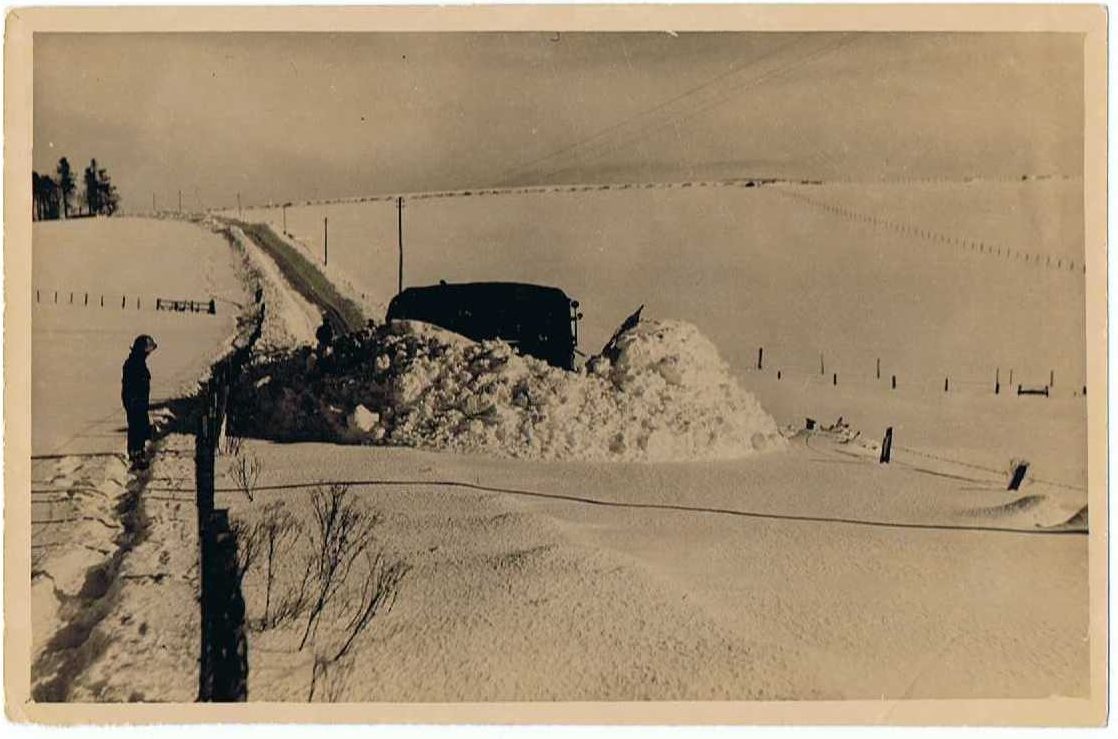
The Snaw Ploo: Original photo from 1957, the Braes of Gartly.
Visits To Grandma’s
By Billy Atkinson
My mother told me this story:
when she visited my father
at his parental home
way back in their courting days
she was out walking with his sister Jo
who turned to my mother and confided
my parents, you know, are incompatible.”
incompatible! well said my mother
of course I knew what the word meant
I’d just never heard anyone say it.
Cathy my mother was born in 1919
in Bathgate a Scottish mining town
she was a great reader
always had a book on the go
a great lover of the movies too
weekly visits to the library
as well as to the cinema
must’ve opened her imagination
to the big wide world
to horizons far from her hometown
And because she, like my father,
seldom if ever talked of the past
that simple story stuck with me
giving me to reflect on
not just the inner life
of my mother’s imagination
but also the lives
of my father’s incompatible parents
my grandparents
Charlie and Mary Atkinson
They lived in Uphall Station
a small mining village
near my hometown Bathgate
I’d visit them on Sundays
and together with my father
we’d walk from the railway station
up the hill to their house
where carved into the stone wall
boldly facing the road the inscription
’Atkinson Place 1894
Different from my own home
but not entirely strange
with the gentle presence
of my Grandma beside me
often only myself and her
in the house in Uphall Station
an odd couple indeed
this small boy and elderly lady
and then that other odd couple
my Grandma and Grandpa
My Grandpa – a miner
a trade union organizer
a founder member of the ILP
(the Independent Labour Party)
a justice of the peace
a lover of jokes and football
a fund of stories of the oul’ days
the colourful characters
from his homeland Scotland
and his fatherland Ireland
A firm atheist with no time
for priests or kings and queens
or fanciful notions
more Thomas and Jimmy Reid
than shadowy Celtic Twilights
his philosophy the School
of Scottish Common Sense,
living with my Grandma
the otherworldly dreamer
her stories of a different sort
She met him in a train compartment
on a journey somewhere
sometime before the First World War
then he’d come to visit her
charming, courteous, good looking,
in the tearoom where she worked
on Portobello High Street Edinburgh
she with her long golden hair
he his dashing Irish good looks
they made a handsome couple
On their wedding day
on that same High Street
heading maybe to a reception
they passed a shop window
she stopped breathless saying
oh look such a pretty dress
come on said Grandpa
no time for such nonsense
taking her firmly by the hand
he pulled her away
At that very moment
she somehow knew…
she sighed and said to me
ah, it’s a weary life
but of course they stayed together
all their days in Atkinson Place
incompatible
and had six children
First two daughters, Ella and Jo
sharp witted capable schoolteachers
then Charlie my father a railwayman
Bill who joined the Royal Navy
lost faraway at sea 1945
Ivan another casualty of brutish war
living with the memory of the stench
and mosquitoes of a jungle in Burma
fighting strangers – small yellow men
finally Eric the youngest wild and wilful
Ivan and Jo were still living at home
with their parents in Uphall Station
and on Sunday visits to Grandma
we were often joined by siblings
sometimes by neighbours
other relatives like Lex Tully
who may have been a cousin
but at other times when I stayed there
for those unexplained longer periods
it was just me and Grandma
Possibly my earliest memory
is however of my Grandpa, in the front room
I’m in a large bed in the alcove
waking to the lovely smell
of porridge cooking
I part the heavy curtains
that screen off the alcove
my Grandpa as always in grey shirt
black trousers and waistcoat
bends tends the coal fire
and then stirs at a pot which is set
on the black cast iron kitchen range
Ah I remember
my delicious anticipation
the steaming breakfast porridge
golden syrup and cream
crinkling its cooling surface
all just waiting for me
mouth watering suspense
one of many snapshots or film clips
that have stayed fresh in my mind
all down the long years
The most vivid memories
from my times at Atkinson Place
are of my Grandma and I
we two alone together
she’d take me to the church
in the neighbouring town Uphall Station
where as we sat in the graveyard
she’d tell me of the spirits she’d seen
hovering over or perched on the gravestones
and how she would talk to them
Then stories of the ”little people”
who live in an alternative magical realm
well known in Celtic folklore
how she’d glimpsed them
and called to them
and how one of the Irish relatives
had come upon one of them
sitting on a stone, puffing a pipe
by the side of a country road
and had passed the time of day with him
She’d tell me how she’d sing
when she woke up
softly so no one else could hear
special hymns on special days
Away in a Manger
on Christmas morning
There is a Green Hill Faraway
when Easter dawned
All Things Bright and Beautiful
for spring and summer sunrises
In that way said my Grandma
she’d bring alive these special times
and welcome them into her heart
importantly though she had learned
not to talk about her beliefs
or demonstrate them in any way
to the rest of the family
they would only ridicule her
but she could tell this little boy
wide-eyed and full of wonder
Once we planned a picnic
all day we prepared things to eat
to drink, something to sit on
many things that took so long
the day was dimming
dusk was settling around as
as we made our way through trees
in the woods opposite the house
finding at last in the gloaming
two tree stumps to sit on
Suddenly out of the gloom
a large figure towering over us
a man holding a shotgun
in the crook of his arm
then his loud jovial voice
oh ho what’s all this here?
a midnight picnic?
I was awestruck
it’s the gamekeeper said Grandma
I was no less awestruck
A child’s visits to Grandma
shadows remembered only by me
a character in my own memoirs
where in common with such stories
with such small childish narratives
there’s always a sadness
even in happy rememberings
so much else that happens
that we don’t know or understand
the hopeful mystery of life.
Chapter Two: Miscellaneous
- Allure Bad News – 2008
- Buddy Holly Show
- Consumption Thoughts
- Coro Veegnette
- Possible loss of computer data
- Emails with J-san on Clichés
- Feeling Guilty about Things
- Fine Line Press interview Jim Smiley
- GB stands for?
- Heartbeat to my Friends
- If I were God
- International Encounters in Kerikeri
- Introduction to Poetry Centenarian
- Memories of Uncle Ivan
- Jack London
- Lots of Love!
- Marylin Monroe
- Meditation Advice to Beth
- Memories of James Gravedigging
- My Daft Jokes
- No Worries!
- Noise
- On Longevity
- President John F. Kennedy
- Prices of & Time for All
- How to Reduce Use of Cars?
- Review by Northern Advocate
- Say Tit Again!
- ScawMaw on Various Subjects
- Scots and Other Foreign English
- Serious Stones in Aoyama Reien, Tokyo
- Life Was Simpler Back Then
- Some of my Lockdown Utterances
- State of Being Human or Show Bliss
- The Gift of Life
- Tinribs & the Glue
- Urine in Latin
- US Presidency in Perspective
- What Makes a Good Doctor?
- Wine Lover and Wowser
- Wisdom in Memory
POEMS
DEATHS
Chapter Three – Travels
A Small Railway Bazaar
Shanghai to Hangzhou, August 10, 1985
The 2:19 p.m. train left at a clanking crawl in a thunderstorm at 2:18. There was nothing too delicate or streamlined about this huge, green, workman-like iron horse until I entered the “Foreigners-only” special-class carriage – air-conditioned, grey-velour curtained, old-world comfortable and sealed off from the other steerage-class carriages. However, it was nothing like the sleek efficiency of trains in Tokyo where we lived and worked.
Tables were set with embroidered cloths and lidded cups containing steaming hot green tea. Our smug security complete, we turned to the slow-passing ramshackle houses of suburban Shanghai. In size they compared well to anything in Tokyo; in every other respect, they made Tokyo look like Beverly Hills or Belgravia. One row of “houses” was a set of railway carriages shunted out of the way, the occupants perhaps old steam-age voyagers or doing honourable train-spotting.
The soft seats, the frilly curtains and the green tea contrasted badly with the view. I got closer to the undulating dilapidated roofs and walls on both sides of the train by going to a dirty, hot, cage-like space between carriages – this provided more of a feeling of oneness with the railway dwellers, as we passed through the centre of their lives. I shared the “cage” with a big old kettle, its leaking corked spout gurgling out hot water with every rocking motion of the train.
In this fashion, we cleared Shanghai in 50 minutes and my conscience allowed me to return to leg-room and opulence. Now it was open country. One field had hundreds of coolie-hatted planters all bent double to the task of growing food for their “county” – good crops of potatoes, corn and cabbage. Irrigation channels were extensive and well made. Small tidy farms had ponds with ducks, fawn and plump. Suddenly from a muddy river surface, a conical straw hat rose up and a naked, weed clearer appeared. There must have been a lot of these workers, as much of the land was watery channels and ditches.
Nearing Hangzhou, at the first and only stop, I was a source of amusement for a group of singletted railway workers hanging over their bath-house balcony. All were laughing, joking and pointing, but in a friendly way. I was glad I was standing in my cage with the window down and not sitting posh and distant behind curtains.
On the platform, a wire cart passed, pushed by a rice seller, shrilly offering “Jong Tsee”, seaweed-green pyramids of heavy glutinous rice wrapped in bamboo leaves. Ten Yuan later, I was surrounded by our Hong Kong and Japanese “soft-class” companions all advising on what exactly was inside my mysterious pyramid. One happy, smiling, Buddha-like businessman from HK said that you go mad if you eat too much of it. So everybody had a toothpickful of the hot, sticky, tasty rice, flavoured with chunks of pumpkin.
As we pulled into the misty, lake city of Hangzhou, we mused that a similar journey on other sides of the world might be Edinburgh to Inverness on “The Highlander”, or Auckland to Wellington on “The Silver Fern”. Train travel begets special train memories full of the outer passing parade and betimes interesting interiors, the luxury of such abruptly stopped for us as we exited in a steamy crush of peasants carrying caged chickens.
We comfortable special-class travellers had somehow missed the special soft-class lounge exit.
Greek Diary August 1970
Sat. July 25: Only one day to departure for Greece
I sent this below to old friends Alistair and Didi for their wedding. Must have arranged to meet them somewhere but it didn’t work out.
“Waited for you but no luck. Flowers withered in my expectation of your arrival, and stars went out as I missed your footfall. A few words here in a hurried moment as I leave on holiday for Greece tomorrow Sunday. I wish you both brightness and happiness for the 19th August. My thoughts will be with you. May there be sunshine on the day for you both. Love, Graham”
Mon. July 27, 1970: Folkstone to Calais, evening
Rough crossing, the sea almost touching the lower deck windows of the bar. Then horizon and sky appear again as the ship lifts.
Arrived Calais at 7.20, train to Milan at 8.00. Switzerland in dawn, very hot as went into Italy. Tunnel after tunnel. Bus to Pavia for turreted Castellano Visceonti.
Tues. July 28: Left Milan by traibn 11.00 p.m. and woke at 7.30 a.m. to sea on one side and thick parched foliage on the other.
Wed. July 29: Arrived Brindisi for lunch in a hotel. Sat around in the sun watching young Italians showing off and shouting, trying to pick up girls.
Thursday, July 30: Left Brindisi by boat at 12:30 a.m. Warm breeze, tug boats guiding the boat out. Salty dew over everything. Everyone trying to sleep in deckchairs. A bright orange petrol stack to starboard as we left the port.
We lay in sleeping bags on deck, looking at a starlit sky, the Milky Way very clear. The sky was like a black ceiling, the boat’s crow’s nest white above us.
On deck in sun all day, watching the deep blue clear sea with only gentle ripples in a breeze.
We arrived Patras at 6:00 p.m. Bus along narrow coast road alternating with toll-paid main roads. Arrived Athens at 11:30 p.m. Hotel Sans Rival, a room for 35 “drax” (drachmas) each, but Friday night was on a roof for only 15 drachs.
Friday, July 31: B/f at café where students usually go during term. Had butter (white and sourish), honey and bread with black coffee.
Beach all afternoon, but had to pay seven “drax” for all facilities, including fresh water showers which had terrific force. It was great swimming and sunbathing.
Shared a two-litre bottle of wine with two Scots, a blokeish type and his girlfriend on the roof of the hotel. Dinner was chicken, spaghetti and olive- oiled tomatoes with Retsina wine at the Placa near the Acropolis with music and dancing in the street. Many Americans, most on holiday but I think some living there, possibly dodging the draft back home?
Sat., Aug. 1st: We gave blood for 314 drax (about 4 pounds 10 shillings).
The boat to Rhodes was 124 drax, leaving at 4.00 p.m. Warm strong wind all night, creating white horses below a clear starry sky.
Sun., Aug. 2: The sea was like the blue plastic water of kindergarten toys, islands uninhabited and barren off the Turkey coast.
Arrived Rhodes at 1:00 p.m. Walked through the old town full of sandal shops, artists’ stalls, silver and bronze ware, streets very narrow with large black smooth paving stones. Carpet shops, bright colours. Furs, bracelets and beads.
The hotel was 35 drax each a night. We found the hospital where James was going to do his fourth-year hospital experience. There were photos of Prince Constantine on the walls. An Unorthodox churchman with long beard and black clothing was going about blessing patients with crosses and bunches of leaves. Everyone was kissing his hands and the leaves. It was most strange with him moving all the while and seeming to take no notice of anyone.
We had a swim in the sea, wild with heavy oblique-angled waves, light blue colour out so far then they got darker. Sand-filled waves but great to swim on the crests. High wind is a frequent occurrence on Rhodes.
Greek chap we met at the café gave us some grapes. He worked there, and after closing he took us to a discotheque. We soon left, they were all younger, about 18 years old!
I watched an old peasant-like woman who got off the boat at Kithnos, the island before Rhodes. In her black clothing she headed with slow steps for shade among some trees, leaving the crowded debarkation scene on the quay with occasional glances back. It was a shorter walk by the sunny quayside but she unhesitatingly chose the tree shade. No-one to meet her but I had the feeling she had done this trip before.
Writing the last two pages on the hotel balcony which is very near the crashing sea. Seemingly no tide, very warm, I was in my pajama trousers only. There was a high wind but it was not at all cool.
Mon. Aug. 3
Beach for afternoon, had to pay five drax entrance fee. Two-hour meal at night with a bottle of Lindos dry white. Windy balcony.
Tues. Aug.4
Beach most of the day in a high wind. Found a cheap place to eat at night in the old quarter. Only about 18 drax each (five shillings) for salad, fried liver, chips and bread.
Wed. Aug. 5
Bus at 12.30 for Lindos. When we arrived there was a strong smell of pine which is the flavouring they put in the Retsina wine to make it taste better. Small cobbled streets, white-washed flat-roofed houses and mules for tourists going up to the acropolis, no other traffic. We lay under the Tree of Idleness in the village square for some of the hot afternoon. Drank wine after a meal out on cafe patio which was just off the street. The streets are only about 10-feet wide. The woman of the cafe gave us green figs which were delicious and sweet. The wine was from Kissamos in the west of Crete, the cheapest at about five drax a bottle.
Thurs. Aug. 6
Woke very early on the roof about 5:15 to the sunrise and flies just before the blazing sun appeared over the hill. It was too hot by 7:00, so nothing for it but to get up and go down to the beach for a swim before breakfast.
Diarrhoea and sickness all day (figs?). No meal at night, I drank water only.
Lindos is famous for handcrafts. You can get a carpet for 80 drax and an embroidered mat for 50. Handmade enamelled pot stands made of china or pottery perhaps at 40 drachs. Brightly coloured designs but they’re very breakable. Small exhibition by Dolo, a German artist. She lived in a house in Lindos for a while before moving to Majorca.
Worry beads
I wonder if ancient Greeks had these to while away the hours. Now in modern times the men go about clasping and jiggling bits of bone on string like necklaces. This seems to do something for them, keeping their fingers occupied; so many people have them and are to be seen shaking them and playing with them. Strange to see, although many of the beads are most beautiful. So many men are sitting around for hours doing nothing but.

(There was no Google 50 years ago, so it was very good to learn now in 2019 that worry beads are used for passing the time, to guard against evil spirits, as an aid to stopping smoking and to show off your wealth by using silver or amber beads. Coral is also used as beads. Personally, I would find it worrying if that’s all I could do with my time, even if I managed to ward off wicked witches.)
Fri. Aug.7
Fit and well again this morning after a long sleep. Flies and sun got me up at 7.00 for a wakening swim. We sat in the cafe during the heat of the day, then sunbathed about 3.00. Went up winding steps to the Acropolis in the evening before eating. Donkeys passed us on the way. There was a view over to a small secluded beach with calm water and a boat leaving a symmetrical wake far behind.
We met three Scots teacher girls at night from Broxburn and Easterhouse, where their school was. Had a meal with them with wine (Plaka) and ouzo, strange, clear, cheap Greek liqueur which goes white when water is added, a poor man’s Pernod perhaps. We had a wild time, the villagers dancing Zorba-like, the girls kidding on the rather simple wee chap called “Lanni” who worked there. (I didn’t think of Lanliq!) He had been tenderising octopus legs down on the beach on rocks and had been throwing them at the girls. We were at the Acropolis restaurant for dancing and drinks till 2:00 a.m. A small boy bothered me with a cricket he was carrying in his hand, its wings all broken. People tend to leave a lot of food, so we helped ourselves to their leftovers, such as cheese and watermelon.
Sat. Aug. 8
Saw a green three-foot long snake down at the beach. Crickets singing, varying the tone of their call, and also varying the speed of it, according to the signal they wish to convey. In chorus they all do the same note, reduce it or increase it to the same pitch together.
We got the bus back to Rhodes at 1.00, taking only 90 minutes. Found a pension up a back street straight away, 15 drachs a night. Must be at least 60 people there sleeping all over the place. The lady of the house has put herself out to sleep on the hard concrete at the entrance. We sleep on hard board, a raised bed alongside two English nurses, Denise and Sally from London. The bed is about 12 feet wide, and seven feet long. We slept across the width. There are bed bugs dropping from the ceiling! Went down to the beach for the last of the sun. Had fried liver at night with Kissamos wine.
Sun. Aug. 9
We sunbathed the whole day with the two nurses. We were glowing at night after all the sun. Went for wine and a meal.
Marvellous chess boards made of copper or bronze, the pieces also of metal. Very expensive, a large board and pieces. The pawns are ships, the knights are sea horses.
Street of Knights in Rhodes was where the knights lived, their emblems above each door. You can look through the gates and see staircases from the entranceway, windows rather like old English houses.
There are pot plants all over Rhodes. They are in large cans (petrol canisters and the like) and they’re painted pink or blue. They set them up on any old ruin to create a riot of colour.
Mon. Aug. 10
Rose at 7.45 with sun in the eyes. Lemon tea for breakfast as I wrote my diary of the last four days.
Skilled artisans work in little dark shops with all their machinery around them, rather like I remember our old cobbler shops.
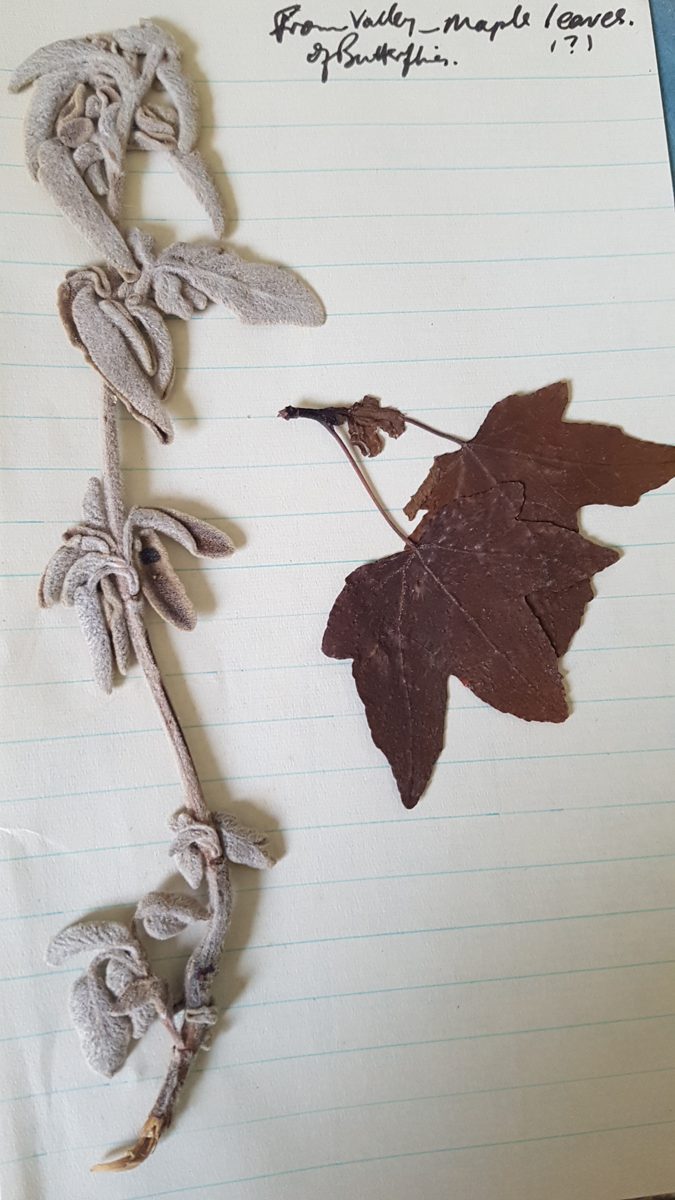
Maple (?) leaves from the Valley of the Butterflies.
I took a bus at midday to the Valley of the Butterflies, only 40 minutes inland. The valley is very small with steps specially made beside the stream which created the valley. There are rickety bridges of rough-hewn pine branches cross the stream. Butterflies seek shade wherever they can despite the close attentions of tourists who insist on clapping, whistling, even throwing stones to make the butterflies (petaloudes) fly up displaying their red wings. They are black with white markings when still. Tourists ignore clearly marked, if comical signs like:
“Do not disturb butterflies by whilsting” (sic). One misguided American girl was clapping them out from under an overhang to ecstatic cries of, “Oh wow!” Then she injured one between her hands, so there followed all the rotten too-late sentimentality with, “Oh, I feel so badly, the poor thing, it’s just crawling about there.” She walked off.
A lot of maple trees with a strong smell, some discharging their heady resin in the heat. Inland Rhodes is very wooded. The maple has a polygonal pattern!
Tues. Aug. 11
Left Rhodes at 9.00 p.m. on a small boat crammed to the deck rails. We were lucky procuring ample space. Retsina Plaka afforded an excellent nightcap under the stars.
Wed. Aug.12
The sea turned rough and the small boat began listing and rolling until many people were seasick. Greeks seem to be poor sailors. There was an old woman dressed in the customary black, below deck. She was feeling very sick, smelling a lime lemon and a bunch of herbs to ward off the sickness.
We arrived in St Niklaus at 2.00 pm. It’s a pretty prosperous town, villa-type houses on the slopes, many split-level homes with ornate stairways.
We took a bus through rough hilly scrubland, all red-earth and barren. Goat-herders. Got to Malia in time for a swim before dinner.
Thurs. Aug. 13 Met Sarah!
Beach all day. Excellent home-made pea-like soup for dinner, would have been a meal in itself at the Acropolis Restaurant. Met Sarah from south of England. Sarah Younges.
Fri. Aug. 14
Beach all day. Steaks at night at the Windmill.
Sat. Aug. 15
Great tumbling waves which twist and throw you about as they crash on the beach. Just like the waves depicted in the old sketches of storms at sea, their curving crests exaggerated with sweeping pen strokes.
Sun. Aug. 16
Sarah returned this afternoon from Phaestos. She said it was too hot there at 123 dgs F. She is a wonderful person!
Mon. Aug. 17
On the beach. We eat every night at the restaurant where we also stay. Excellent wine made by the manager’s father at 10 drax a bottle. The manager often says at busy mealtimes: “Too many people, a lot of people, marvellous food, expensive to buy and expensive to sell.”
Tues. Aug. 18
We went with Hilary, Sue and Sarah to Iraklion and thence to the Minoan Palace at Knossos, spending all afternoon there. The excavations were fascinating. English archaeologists at work in a 20-foot deep pit, excavating with a rubber basin on a pulley. There’s a corridor of the magazines, huge urns in crypts for storage. The Palace had a grand staircase and upper hall of royal guard. There’s a lustral basin theatre, throne room, drainage system, lapidary’s workshop, staircase of the draughtboard, staircase leading into palace, small houses outside the palace for artisans, and much more.
Sarah and others stayed on after we ate with them, returning to Malia on the 8.40 p.m. bus. They were going to Athens by the Wednesday boat. We will perhaps meet Sarah in Athens. She wants to go to Delphi while she stays in Athens with friends before going to Paris to stay with a friend.
Sarah Younges, Forest House, Rowledge, Farnham, Hants (Recently in 2024 on sale for over three million pounds!)
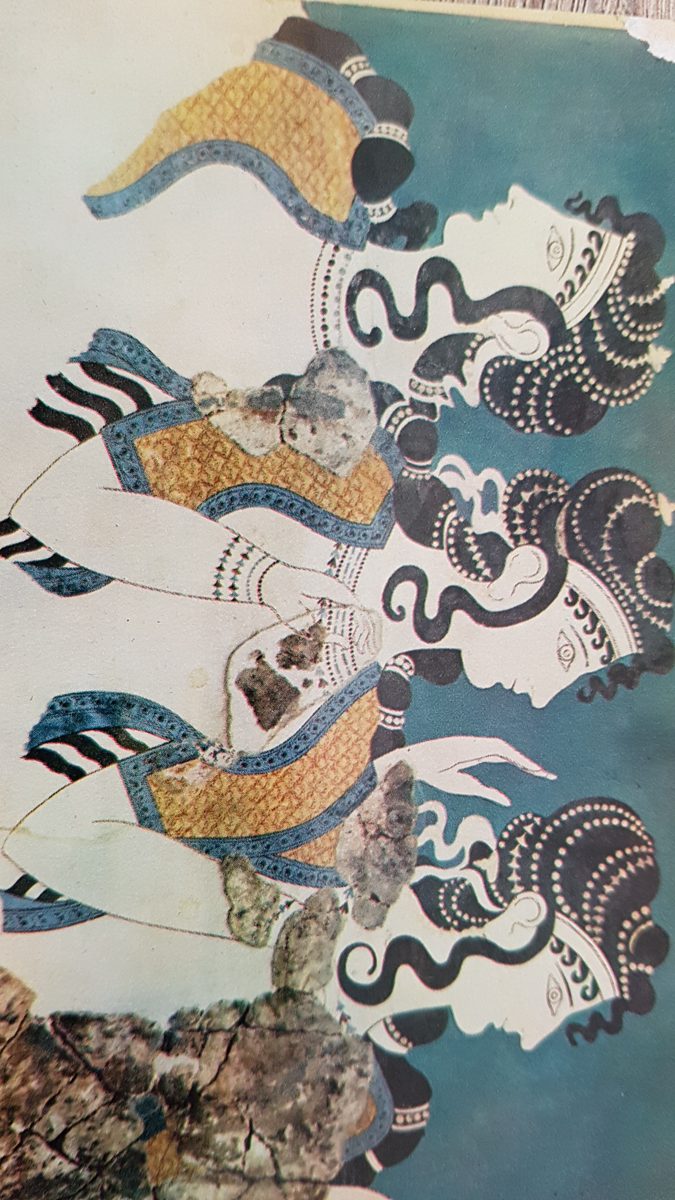
“The Ladies in Blue” at the Minoan Palace, Knossos.
Wed. Aug. 19
Beach again, met two girls, PE teachers. Too much! Beach at night.
US Air Force. Share out (sic) ouzo shakes and Minos wine with lemonade (hideous!). Swimming at 3.00 a.m. in very warm water.
Thurs. Aug. 20
Reunited with Sue and Janet, two girls whom we had met before with two blokes but they’re now on their own. They’re from Newcastle where they’re doing teacher training. We slept on the beach tonight, very pleasant to wake in the morning and crawl out of the bag and refresh oneself in the sea. If ever come to Greece again, this is the way to sleep all the time!
Fri. Aug. 21
Our last full day on beach at Malia, which is a really great place with just enough people around to have fun at night, and very few ordinary tourists. We drank some Minos, ouzo and home-made wine on our last night. Met a great bloke, Dave, a classics teacher from Featherstone:
“I know your name, it’s Alice and your mother’s a white rabbit,” he said to a girl who had said cynically to Dave she’d been in Malia for three years. And to a Liverpool bloke who was fooling about:
“All you need is 20,000 eagle feathers and you can leave Crete tomorrow, but the first chap who tried it, didn’t make it.”
Sat. Aug. 22
Sad farewell today at 1.00 p.m. Janet very sorry to see us go, but we promised to go to Newcastle to see her when we get back. As we left, already people were taking our places in the group we had created in Malia.
Met the degenerate drunken bloke from Dublin in Iraklion. Really an interesting knowledgeable person but with a distasteful manner. He told us about the American bases on Crete. He was in free-lance electronics at home. Americans are in control of most of Greece with communications and monitoring bases. They’re watching the Russians. (Note: It’s Argentinian pressed beef in souvlakis.) Boat at 7.00 p.m. There were French kids on board, smoking marijuana. They tried to take over the boat! There was some fighting as we tried to sleep. Thought “Mary Jane” supposed to be calming.
Sun. Aug. 23
Arrived Athens at 10.00 a.m. Met Sarah at the Acropolis at 3.00, marvellous to see her again. Thousands of people with every type of camera, scuttling up the slopes as if to attack the citadel. Walked around the town at night quenching our thirst frequently.
Mon. Aug.24
Up at 6.00 a.m. to go to a monastery on a hill opposite the Acropolis. Magnificent view of Athens at 7.30. The pillars of the Acropolis were placed or shaped in such a way slanting in towards the top, so it looks flat and two-dimensional from a distance, as was intended.
We met Sarah at the blood bank place at 8.45 but we had changed our minds about giving again. We parted from her since she was waiting to find out about her flight to Paris, and then going to stay with friends in Athens. Bad luck about our flight which was supposed to be 5.20 Tuesday morning tomorrow. (Must have been cancelled?) Had been looking forward to it. I have booked the long trek of three days (the same way we came) back to London on Wednesday for 19 pounds (1400 drachs).
James thought of going to the airport tonight in hope of a cancellation, but then decided not to.
Tues. Aug. 25
James was ill, so went to beach on my own. Same eating at night.
Wed. Aug. 26
Left Athens at 2.30 p.m. on long bus ride with ferry crossing arriving at Igoumenitsa at 2.40 a.m. then sat in café open all night with two English girls until 5.00 a.m. We waited on the pier in the dawn till 7:00 a.m.
Thurs. Aug. 27
Excellent day of sunbathing on deck en route Brindisi, arriving at 7.00 p.m. Train at 9.30 p.m. all night to Milan arriving 10.30 a.m.
Fri. Aug. 28
I went to see Leonardo da Vinci’s “Last Supper” at Santa Maria Delle Grazie. Tramcar there in 15 minutes. Amazed to find that it was painted in a room attached to the church, on a wall, a mural! Da V’s method of painting and paints he used caused difficulty because of humidity in the room. Anti-humidity steps were taken and he continued. Often spent days over one aspect of the painting. Started 1445, finished 1495 (?). The building was bombed in WW2 but luckily the wall of “LS” was protected with sandbags.
Information from a machine:
“Marvellous use of perspective in painting, Jesus the central dominating figure and yet also looking isolated. Typical method of 15th century school of painters. Apostles seem to fan out from him in awe. The use of light and shade, clarity of background countryside show it was approaching evening. The mural is about 12 yards long, the full length of the back wall. Painting in same room by contemporary of DV, Montrefeno (?), not the same synthesis of detail or centralisation of action, his painting of the Crucifixion.”
To me the marvellous aspect of the mural was the use of perspective, the way the wall seemed transformed into a room with a table, the whole going back to windows and open countryside.
Greek diary, Aug. 1971
Wed. Aug. 11 Boat from Ios to Santorini, a volcanic island.
There are 587 steps from the wharf to the top of the crater where the town is. Many American tourists dropped in to keep busy the docile, inscrutable and unresponsive mules, heads down, plodding their twisting way up.
James & Claire left on the 5.30 p.m. boat back to Ios. I experienced my usual wallow in self-pity when I say goodbye, left on my own. It could be 100% self-pity or it could be 50% genuine feeling for people for whom you really care – not at all sure what exactly. Anyway I felt awful for almost three hours.
I was much better at dinner in a small restaurant where I had bean soup and “fishes” (sic), total cost 13 drachs. I was joined by two girls, one from Surrey, the other from Somerset. I felt much better with people to talk to. It seems I have a loneliness condition or some such. I get a bit sorry for myself. Maybe it’s common, other people feeling that, too, dunno. The girls had come from Crete and had been to Malia, saying it was good but the beach was too windy and the waves full of seaweed.
I got almost back to normal when one girl told me she had been to New Zealand for a month and had had a tremendous time what with the beaches, scenery, people and Maori culture. Everything was great! She said it’s much the same as in Britain without the mercenary attitude and the industry. She said even the films were the same! She wouldn’t hesitate to go back there if she got the chance. Interesting to hear what I need to help me to look forward to.
Thurs. Aug. 12 To Crete
Sunbathed all afternoon on boat to Iraklion. Got to Malia at 7.30 p.m. without mishap. I was given a bed under the bushes at the Windmill, Costa’s place where James and I stayed last year. I find it hard to think that here I sit in such warmth and beautiful surroundings after eating at Costa’s, the wonderful scent all around like evening scented stalk, only much headier, and in only two weeks I’ll be back in Edinburgh or at home in Perth.
The self-pity stuff stems I think from a feeling of how wonderful it would be if I had a friend sharing this enjoyment, increasing it. There’s a lot of self-pity in it, which is difficult to admit. I feel hard done by, also that I’ve made a mistake coming all this way on my own, to constantly wish there was someone with me or even that I was simply back home. Nights are easily the worst, quite desolate and always trying to think of ways to cast a brighter light on things, counting the days and nights till I get the boat again, anything but simply enjoying the moment. I often wonder if other people can feel so bad. I sincerely hope not!
Costa’s is costing 25 drachs with breakfast which is the best deal yet. Bed under the bushes is the same as if I took my bed outside at home and shoved it under a lilac bush. It’s cool and doesn’t get the sun too badly in the morning.
I’ve got nine days left with a lot of time to myself, a chance to think and get things right, not to be wasted by moping and wishing that things were otherwise. There was more to Herrick’s rose buds quote than just pleasure for its own sake. The idea is to make the best of things while you can. Get a grip on life, don’t waste it, don’t squander your time, lots to look forward to.
If I were at home now I’d probably wish I were away elsewhere. Maybe I’m never happy in one place. Wonder what New Zealand will be like, no friends at first for sure. Much further away than here! I now wish I’d been able to find work in Greece. New Zealand feels very remote and three years there a very long time.
Mon. Aug. 16
It has been the oddest existence I’ve experienced for some time here over the past few days. Stranger still is knowing there are another four days of it. Saturday, the 21st will end the routine of sleep, eat, read, swim, sunbathe, read. I’ve experienced this kind of routine before in other forms. For example, in Edinburgh where I’ve had nothing much to do for several days. The great difference here is I’m alone, whereas in Edinburgh I could colour the days by talking to people, actually able to seek them out, and knowing that something different might happen. It’s easy enough to say that such happens here to some extent, meeting people regularly but I don’t know that some night I will have someone to talk to. The hard bit is not knowing. The combination of heat, routine and security make me know what it must feel like to be semi-retired. My movements have become slow and relaxed. There’s plenty of time, no urgency. Actually each day is a playing out of all the old moves plus thankfully some new ones.
For example, today I tried to fix up an excursion to the south of Crete on Thursday, a good way of breaking the pattern of days. I didn’t manage it but the act of trying was an indication that things are not the same always, a sign that I was still capable of injecting novelty, at least trying to. Intention can be helpful.
At breakfast this morning the girl came with my coffee and bread, and greeted me in Greek with “Kalemera”. Whether or not yet fully awake or more likely not practised in saying good morning in Greek, I acknowledged with a tilt of the head and raised eyebrows, which must have looked not comprehending. Whereupon, she said “Bonjurno”. This time I felt to say “Good morning”, a mechanical reply. It all seemed a bit ridiculous that three languages could be bandied round the tiny breakfast table, all mistimed, superfluous and not necessary. A nod or a smile would have been enough. I wished I’d managed “thank you”, even in English for the coffee!
Later there was an English family, just parents and a 15-year-old son, sitting nearby. They were playing Scrabble. What a mess! The kid’s spelling was atrocious. He asked dad how to spell “sinned”. Dad duly spelled it out for him with two “ns”. The boy asked if the word “sined” would be all right, giving away he had only one “n”. Dad told him that it wouldn’t because that would be pronounced “signed”. He probably didn’t have a “g” but wouldn’t have known what to do with it anyway.
Tues. Aug. 17
Met four Scots girls from Glasgow, all teachers at the same school. During their month’s holiday in Greece they found out that their return flight was delayed by one day. The result would be arriving in London at 9.30 a.m., a half hour after their school started for the new term! Jings!
Thurs. Aug. 19
Wakened at 6.30 this morning with a heavy raindrop on my face. Not much cover afforded overhead by the canvas and bamboo mattings. We all sat up in our sleeping bags and huddled into the middle where there was great shelter. It reminded me sharply of camping at home and waking inside a dripping tent. The American beside me drawled, “I just knew this was going to happen. I wakened at 6.00 and it just looked as if it was gonna go ‘whoosh’!” Another American just lay there on his bed, smoking a cigarette keeping calm. He had slept in his clothes with no cover, just leather jacket and white jeans. He was slightly balding with a receding hairline and a drooping handlebar moustache. All too cool.
I walked up into the hills behind Malia since it was such a dull morning. There were pigs eating tomatoes and watermelon, also goats, cows and hens. I said, “Kalemera” quite briskly to a woman in a field, and she replied similarly with stress on the second-last syllable. It felt like at home where you would say, “Morning” with some substance or politeness according to your feelings about the morning.
Sunday, Aug. 22
Beautiful houses on the coast road from Athens to Vouliagmeni beach. All curves and clever angles to create shade. Verandahs and balconies, little forecourts and pathways. One nightclub looked hideous, as if a huge tarpaulin had been dropped over a structure and then had a thick blue-grey paint dropped over it, all drips and jagged edges, totally grotesque.
Again the Athens thirst has hit me. Actually wonderful to have to quench thirst constantly with cold milk, water, lemonade or orange juice. The thirst after food is particularly strong. Like the French, only more so, the Greeks drink in a civilised way. In Crete they served “mezes” or snacks with most drinks, particularly ouzo. You get little plates of olives, cucumber, tomatoes, peaches, pears and fetta. More of this kind of practice at home would help to make our drinking more civilised, I feel for sure.
Tues. Aug. 24, London
The Rising Sun on Tottenham Court Rd., like what a bar should be, carpeted with a false ceiling tastefully done in squares and cream coloured rafters with fleur de lys picked out on them. A gold metal foot rail followed the L-shaped curved bar. Gold lanterns all lighting up maroon stippled walls. Chairs were leather backed with gold studs. There was a great selection of draft beers, a range of food on offer, nice surroundings. Tuborg Lager on draft. Danish ham, chicken, basins of salads with French bread, tomatoes and sausages. A cheese selection. Metal crockery! I was home!
Keeping on the Move
(Adapted from a letter to old friend, Jonathan back in early 2000s)
I have been pondering a bit of late how I am more carefree on the move, how a kind of ennui sets in if I’m in the same place too long. I think this was ever the case, so it’s surprising that I should feel it strongly now. I wonder if it’s to do with “retirement” or as a friend, Jonathan so elegantly put it “redirection”? His imminent departure going back to Tokyo reminds me of his saying years ago about push-pull factors in big decisions. Pushed away by the yob culture? Pulled by a more civilised place, a desirable job? But isn’t it really a visceral need to keep on the move and be happiest in that.
The moving is the satisfying thing, or rather satisfying a need not to remain in one place too long because it becomes dull, no matter really how interesting and good your life is where you are.
The French say something about being “dans la peau”. Skin happy?
Funny how I can lose interest in where I am, how the place we move to becomes stale, how the place we could move to becomes more interesting even if it’s going back to something we know well.
So it’s the moving, not the arrival or being at a destination, I would say.
RLS was right: “To travel hopefully is a better thing than to arrive”. He also writes about being on the move in “Travels with a Donkey”. Allan sent me a great article about crossing the Cevennes in Stevenson’s footsteps. So there’s travel to and travel in. Maybe the solution is to organise constant movement somehow, something to look forward to. Or just manage to live for ever in the kind of feeling you get when you see out the window the apartment blocks of Kowloon, the Languedoc’s vineyards, the kiwi fruit orchards near Auckland or the rice fields around Narita.
Maybe just the thought of everything somewhere else is enough. Pity we won’t be around when they invent totally private means of travel, such as self-propelled Zimmer frames.
My Travels and Home Thoughts
I recall a lovely moment when I was seven years old leaving the Braes of Gartly in the hills of Aberdeenshire with mum and dad in the van on our way to England on holiday. I strongly felt the joy of leaving normal life for sights and pastures new. Now travel represents for me nearly 70 years on an escape from daily humdrum, a possibility of nothing but oneself and the unknown which you don’t have to worry about or see to, just take an interest in and be thrilled by.
Do you know that song, “I’ve been everywhere, man, I’ve been everywhere”? It was written by an Australian songwriter, Geoff Mack. He says he’s been everywhere and goes on to reel off all the Ozzie places he’s been to. Well, I’ve been to a few countries in my time, mainly cities, living in Vancouver, Edinburgh, Wellington and Tokyo, and visiting London, Paris and Brisbane many times.
’Cos I’ve been everywhere, man
I’ve been everywhere, man
’Cross the deserts bare, man
I’ve breathed the mountain air, man
Of travel I’ve had my share, man
I’ve been ev’rywhere!
I’ve been to
Tullamore, Seymour, Lismore, Mooloolaba
Nambour, Maroochydore
Kilmore, Murwillumbah
Birdsville, Emmaville
Wallaville, Cunnamulla
Condamine, Strathpine
Proserpine, Ulladulla
Darwin, Gin Gin, Deniliquin, Muckadilla
Wallumbilla, Boggabilla, Kumbarilla
I’m a killer!
Well, I have to say I’ve been to only a few of those places in Australia but there are several in the song not mentioned that I’ve lived in or visited. The one I lived in was Mackay in north-east Queensland, just for a year teaching at TAFE, short for Technical and Further Education. A few other places in Australia I’ve visited are Adelaide to see friends, Canberra for friends and the parliament building, Sydney for friends and Melbourne for it’s art gallery, a cemetery and staying with friends. I would love to take the train, The Great Southern from Adelaide to Brisbane or The Indian Pacific to Perth.
My primary school education was in seven different places: kindergarten in the south of England and also a school there for part of primary one, then four years at my mother’s one-teacher school in Aberdeenshire, a year in Vancouver in BC, Canada, followed by Primary Six and Seven first near Aberdeen then Perth before secondary school for six years at Perth Academy, then it was on to university in Edinburgh – a fair bit of moving about for my education.
I mentioned a year in Canada. It was in Vancouver where my mother had gained a position as an exchange teacher. She had already done that in Los Angeles in 1947 before she married. We sailed to Montreal on The Empress of Britain which provided many good experiences over the five days, including playing the piano to an audience – I had to be pushed into that by my mother! Then it was five days across Canada on the Canadian Pacific train. Of course we had to do some travelling from Vancouver, and I’ll never forget a long bus journey to Dawson Creek in the north of British Columbia. Then for Xmas there was Mexico City, my mother having gained work there for a few weeks looking after the two children of a British Embassy official. She took me by rickety bus to Acapulco, an exotic beach experience.
In 1962 when I was 14 and my cousin, Billy was 15, my mother took us both to Paris for two weeks. She did it again the following summer. So started my lifelong love of the City of Light. Paris was my mother’s great gift to me for life, as I have returned there over 50 times, mainly keeping to the residential parts rather than where the tourists throng. (For a great embellished memory of that holiday and city, see “Young Lads & Ladies of the Night – Paris, 1963” in this book.)
I trained for a term at a fine school near Wellington, then taught for a year before heading for Training College in Christchurch on the advice of the principal telling me to get the professional qualification to stand me in good stead. I taught for three more years at the secondary school before taking a good job as a Communications Tutor at Wellington Polytechnic. The greatest thing about this was the variety of students, ranging over technicians, nurses, musicians, plumbers, scientists and hairdressers!
This was followed by a year in the north of Queensland, at a Technical and Further Education College in the city of Mackay, well known for coal and sugar cane.
My wife, Beth and I lived and taught English in Tokyo for nearly 20 years, a huge throbbing megalopolis and an even bigger urban sprawl if you include Yokohama. The population of the metropolises there, including Kawasaki is nearly 28 million. Even more amazing is how the Japanese manage to live in a civilised way, probably the politest people I’ve ever met.
We did a fair bit of travelling within Japan. For example, going round the main island of Honshu by train for a week. There was another week of train travel to Kyoto and on to the northern side of another island, Kyushu. We also managed to visit Shikoku island – that was for an English teaching conference.
There was a great weekend near Sapporo, capital of the northern island of Hokkaido. It was for a 10-kilometre race. (There’s a good story on this in the section “Japan Tales”. It’s called “An Ambitious Run in Hokkaido”.)
To escape the constant thrum and bustle of Tokyo we treated ourselves many times to weekend and national holiday trips to the countryside. The best was to Lake Nojiri in the mountains of Nagano in central Honshu. (For more on this beautiful lake see the story in “Japan Tales”.)
Since we were in Japan, travelling to Asian countries was a matter of hours away. So we visited Hong Kong several times, also Macau, China, South Korea, Malaya, Singapore, Thailand and The Philippines, all wonderful and interesting places. We also made it to India, taking the great train, Palace on Wheels from New Delhi through Rajasthan to Jaisalmer near the Pakistan border, a week-long return trip. It was well named Palace on Wheels because it visited several cities with huge exotic palaces at Jaipur, Udaipur, Jaisalmer and Agra.
Most of our travels were to do with going to our respective parents’ homes in Edinburgh and Wellington, very easy from the halfway point of Tokyo, usually for the Edinburgh Festival in August and for a summer Christmas Downunder.
There were many New Year visits to old friends in Noosa on the southern Queensland Sunshine Coast. One time I went to a great sanctuary on that coast, for wallabies, kangaroos, kookaburras and of course koalas. I had my photo taken holding one of the koalas. Funny creatures, they think you’re a tree trunk, so they clutch you, the reason you have to wear big long leather gloves, otherwise they’d claw you, not intentionally of course – I don’t think there’s a bad streak in a koala’s body, except it could harm you.
Travelling On
(Some of this was used in my piece entitled “Lifelong Traveller” in my book “Gushers – People Real and Imagined Talking”.)
There are thoughts and feelings about travel and moving on that come over me. I have a strong sense of other places, especially when I hear that other people are going to visit there, then I wish that I could go with them, too. I also love thinking of them enjoying being elsewhere, seeing them clearly if I know the place they’ve gone to.
When I go with people from the wine village of Pouzolles in the Languedoc to farewell them on the train to Paris I wish that I could jump on the train, too. It’s the anywhere but here feeling, even though where I am is totally wonderful.
To give a good example of the above, old friend, Denis and family visited for a week in our village in the summer of 2008. On their departure it was an early drive to Montpellier to get the 9.40 a.m. hi-speed TGV to Paris, and I wished that somehow I was going with them, not staying behind. Maybe it’s a missing out or the excluded feeling I’ve still got from childhood, and nothing to do with the desire to travel. I prefer to concentrate on the latter!
A couple of days after Denis left I had a great thought – way too late and impractical – I could maybe have got a train from nearby Béziers, only 15 minutes away, and arrived in Paris before him, meeting him at the station to help with the baggage. I think that was the time I gave Denis a litre of wine for the train. He said he arrived drunk in Paris!
Crazy travel stuff like that is what dreams are made of and money permits! Or wisely dismiss and simply get on with where one is. In that case I was actually on holiday travels from New Zealand, so it would have been travel within travel!
I have found over the past 35 years that I have to travel very light, something I was forced do after I broke a shoulder bone and simply couldn’t carry a heavy pack, a great thing making travel so much easier! I now wonder at people travelling with far too much stuff, probably taking much of the contents of their home, thinking that they need it, that they’d feel alone without the familiar things of home. Travel is better without all that stuff, so you’re more comfortable and freer to enjoy everything around you, all the new experience. I know that many other people manage to do it. Likewise some people manage to make it difficult if not impossible.
In some ways I’m a real stay-at-home preferring not to leave my abodes because they are now where I work and write, but every so often I get a strong feeling of needing to go somewhere. However, I can usually satisfy that by thinking of Paris or Brisbane or Tokyo or wherever, safe in the relief of knowing that I’m going there again sometime. I don’t have to rush off somewhere just because I feel like it.
I think I have been something of a true traveller if I define it as something to do with going to new places on one’s own. Now I think I am just a tourist with more certainty about where I’m going. I like living in various countries without getting involved to the extent that I come to disrespect or feel bad about them because I’ve learned too much about them and how they’re just like everywhere else. I only want some pleasant surroundings away from the usual environs for a while, without the over-familiarity of home. Maybe that’s what was so good socially in Tokyo – it was all surface, and we were unable to understand so much in that complex culture. I think I really appreciate my time in the South of France for that. I don’t bother with the news and stuff out there so much.
People who travel want or need things to be different. They travel seeking something new. They also notice how things are the same, though.
One of my biggest travels was by Greyhound bus across the US to Los Angeles, San Francisco and Vancouver, then back again via Chicago. I had attended Expo67 in Montreal that year, 1967, the “Summer of Love”. I stayed in a YMCA in central New York, visited distant relatives of my mum in Washington DC, and stayed with more relatives on their ranch in southern Indiana and hitched a ride from Flagstaff to the Grand Canyon. (See “Across the USA by Greyhound” in this book.)
People who travel want or need everything to be different. They travel seeking something outré in their lives. This also helps them to notice the way that many things are the same, though. As I’ve grown older, I have appreciated being able to travel in more comfort. No more sleeping rough in train corridors or caves and roofs full of beds like in Greece.
The motto now is make travel easy with lots of bookings, sleeping comfortably and travelling light.
Home and Away Thoughts June 4’05
Many years ago in Wellington in New Zealand in the late 1970s when I was living at a meditation centre, one of the teachers said: “I have no home, I’m building one in my heart.” These words have stuck with me ever since because I think it must be the same sentiment that has supported me through living in six countries and having many “homes”.
I grew up in various places, in loving homes ranging from one on a stormy island in the furthest north of Scotland to a cottage in the soft, chalk landscapes of the south of England. The locations were always in the countryside so I came to love nature and all the weathers that characterised these extremities. I was happy insofaras I was greatly cared for and wanted for nothing in terms of the simple good things of life: beauty, nature, books, fresh air, walks, trees to climb and the ever-present joy of learning. Home for me was very tied to my treasures: books, comics, cards of all kinds, objets d’art, photographs, notes, posters and bits of nature, such as stones, shells and wood.
But there was a constant refrain in my upbringing in my mother’s words: “This is not everything, there’s more to life”. She meant travel, having gone to and lived in many places herself but never enough, so it was up to me to do more travelling for her.
The “not everything” theme with my mother was satisfied for her probably by lots of departures. She seemed to specialise in them, whether it was on a daily basis to go to work or a weekly thing to go to a school conference or taking a longer trip to see her family or “going for a run” – the expression used for going somewhere in the car, usually on a Sunday for a picnic to the hills or beach. Then there was the annual two-week holiday camping in Scotland, England, Ireland and France.
We moved a lot. We had lived in seven different places by the time I was 12, and as if all that change wasn’t enough I was told, “You have so much to see, so much you can do”, perhaps too much of a risk for me to work this out for myself, an exhortation perhaps to make up for my mother’s lack of satisfaction with her life which she wished was all travel, all exotic, all totally interesting, anywhere but here. She had been told by her father: “Aye, the grass is aye greener on the other side with you.” He had been born and lived in the same house for his 88 years. What he thought of his younger daughter’s peregrinations, especially going to live in Los Angeles in 1947 for a year, is encapsulated in that wry comment about the greener grass.
Home for me was as much about feeling I was content in one place as being taken imaginatively out of that cosy home. I mean I was often told there were other places, given information about other countries, shown pictures of palm trees and orange groves and people with strange head gear. More specifically, my mother had a heavy deep crimson photo album with huge black pages filled with photos and postcards collected from her year teaching in Los Angeles in 1947. In quiet moments when I wasn’t “being wild” chasing “red injuns” in the woods, climbing trees, fashioning swords and spears from beach tree branches or just pretending I was Captain Oates heading off to his frozen death – the hills of Aberdeenshire were cold enough to allow that easy simulation! – I would take out this photo album and look at my favourite pictures of the Hollywood Hills, of desert cactuses, of huge silver buses carrying people heaven knows where, of the Grand Canyon and my mother astride a horse on a track. Invariably my mother would say something like: “You’ll be able to go to these places yourself some day.”
I suppose something we both had in common was a mixed-blessing, the inability to remain in one place for too long, either physically for both of us or in the magical realms of memory for her and of imagination for me.
Home –Where and What?
Home! Possibly in its fullness and security is ironically where people sometimes wish they were somewhere else! To most people though home is where they were brought up or where they have family and friends. I must have missed out although I came from a very loving home and have many happy memories. When I say “missed out” the situation now is that I feel rootless without a culture that I love. To explain, when I go back “home” to Scotland where I was born and lived for 22 years, I see people that clearly are firmly rooted there, have their family there, feel they’ll live there until they die. Well, all that kind of thing didn’t excite me greatly. I took off after university and although it was sad leaving, when I got to New Zealand, about as far away from Scotland as one can get, I never really thought about going home again. Maybe home had become where I was, a kind of self-centredness in a good sense. Certainly, this was reinforced when I went back to Tokyo recently.
It’s a funny feeling always when I go back to my first home – I mean it always feels odd because it’s where I lived so long, and it was home, where I worked, travelled and had friends, and it is familiar up to a point but Japan is such a very different country to other places because the people and culture promote that; they’ll often say “You have to understand us”, as if they are difficult to understand or they like to think they are inscrutable or some such. Can you imagine government or any other institution Down Under saying to anyone else we are so enigmatic that you’ll have to make a big effort to understand how we think and what we feel?
It was so easy to be there, so relaxed and interesting to be in New Zealand and Australia. I felt at home but also travelling and in a foreign place! That’s an interesting condition, one which maybe I’ve been encouraging for many years ever since I was 22. Still, I’m left with a feeling of no home and many homes.
Travel & Life at April 2026 or 78 Years
Travel Early 2000s ?
Going to other places reduces intolerance. If we have contact with only the same environment and people, we can become intolerant of them very quickly. But I am experiencing a rejuvenation and revitalisation of the spirit of feeling good about the glorious English countryside and people. It’s the softness, the accents, the different ways. Such had become intolerable to me before. Actually, truth to tell, I didn’t notice them.
Being Somewhere Else
Elsewhere is a thing of the imagination, so will be much more attractive than where you are now because of the weighty and weighing-down nature of being in a body. How to lighten the body so the present is akin to thinking about it? Got to fine-tune the nervous system and the mind, got to practise fullness and emptiness. I also think it’s a good idea to reduce weight and drink lots of wine!
Why do people travel? They have an image that somewhere else is
better, that they will feel better elsewhere. I wonder if lucky, wise and good the person who has no need to do that. Perhaps unlucky the person who would like to but has to stay home!
Going Away / Being Elsewhere June 1 ‘06
Amazing how no sooner here in the South of France than I’m thinking about the departure, about what flights, if I’ll stay two or three days in Tokyo on the return flight, what hotel to stay in, good things to see and do.
It’s true what they say about going away to make you appreciate home, or at least somewhere else. Actually, recalling our large property in New Zealand feels quite attractive at times, something to do with the more homely feel of it, the less foreign feeling, or some such. No doubt I could write exactly the same kind of thing when in Paraparaumu, feeling how wonderful it is in France and wishing for that lifestyle. It would appear that unsettled feelings arise in spite of my great good fortune to be able to live in two places. Maybe I need a third place!
Life May 24, 2006
Thoughts of the philosopher R.D.Laing on meditation from a programme recounted by David Kelly on walk at Stoke St Gregory, where Kelly was doing basket making in 1979 – it’s a journey away from Self then turn back to Self. If not got Self then one will see such organisation too much as a mother figure, and become too dependent. If you’ve got some sense of Self then you’ll be able to see such for what it is, an aid to the wholeness of the world.
Maharishi certainly saw it this way – no laws and rules to follow, no holds. R.D. Laing recommended meditation to all his patients whom it would suit.
A Real Carriage on train from Bristol to Newport.
First class, very nice with curtains and mirrors and working lights. It’s an empty carriage, too, for feet up stuff. Almost as if he felt cheated by circumstances, the guard, having missed out on working on the Inter City fast trains, could only nod silently and sourly when I asked if this was the Newport train all right.
Purpose in Travel? June 18, 2016
Just leisure and joy of it? What’s the result? Are we too bound up with fleshing things out, that the result will make the travel better, or that it has to be better? Why not just travel elsewhere? It’s good for the soul.
Travel July ’09
Travel isn’t about moving. Travel is about being here, being there, being anywhere, being everywhere. It is a feeling for place and people, for different places and different people. It is about being one with oneself in each place, with all people.
RLS probably said it best though: “To travel hopefully is a better thing than to arrive.”
Travel Story for “Hot Air” (Virgin Inflight Magazine)
Oct. 14, 1989
Well, look at this! They want a travel story in 750 words. I glanced sideways at the Japanese businessman, Suzuki-san in the seat beside me. I had conversed long and interestingly with him. He was fast asleep. It had been a tasty meal with a good white wine, and I hoped that he was dreaming of distant lands befitting the excitement and convenience of being able to travel direct from London to Tokyo in 11.5 hours on Virgin Atlantic’s latest route.
Now we were somewhere over Russia and he was well gone. Poor man. If what he had told me was true, his life was an unenviable grind of tight schedules and compulsory presence in the office for long hours. About once a month he went overseas, and he admitted that this was a change. Note the absence of epithets “pleasant “ or “refreshing”. That would have been too direct, and an indictment of his job in Tokyo, no matter how awful in reality.
I started to muse on what it would be like to be in Suzuki-san’s position, to be Suzuki-san. I could hear his wife speaking to him early in the morning.
“Oide! (Hurry up!) You’ll miss your usual train, then you’ll have to stand all the way.” He was being bustled out of his 3-LDK “apato” by a brisk and energetic wife whose traditional breakfast he had wolfed down in three minutes. He wished it was always a little kipper-like fish, soup and rice every morning but the kids weren’t keen on it, so they had compromised on toast, jam and coffee consumed every other morning. Anyway, it was easier on Mrs Suzuki. He slipped into his highly polished black shoes, prepared by his wife.They were in the “genkan”, the space for shoes at the door, grabbed the telescope umbrella and slim soft-leather briefcase and was off to the sweating calm of a packed commuter train. Luckily he always got a seat because of living near the start of the train line.
After he had read the ads for hotel bridal parties in which a wedding mama smiled prominently, he drifted into 50 minutes of sleep. He should really have done some English homework for the lunch-time class but the breakfast had made him sleepy. He started to dream of his boss, a nice enough man if you did all the work on time, if you were always at work, but a veritable fiend if you went home before 10.00 p.m. with work still to be done. The overseas jaunt to London, packed with business and meetings, must have been a dawdle in comparison.
Suzuki-san woke up briefly when the steward brought landing forms. He ordered a drink and went back to sleep. I tried to stop thinking about him.
This was the way to fly: I could dream on more space than usual, a thoughtful vegetarian meal, a few wines, a good book and excellent in-flight service and entertainment. Fond hope for Suzuki-san! As a Japanese businessman in all likelihood he was dreaming nightmares of the next time he would have to leave the safety of his beloved company.
It might have been the wine that was turning my mind to writing or more likely the thrill of the flight knowing that we would both soon be in a completely different culture – well, very different for me – soon again to become one of the 120 million electrifyingly busy-looking bods scurrying about on the bits of islands broken away from mainland China. I was glad I was in touch with the strange contrast of hurtling through the air from west to east while at the same time keeping in touch with both by recalling the London I’d just left and the Tokyo I’d lived in for seven years.
Strangely, I had found London faster, harder and more torrid than Tokyo. I put it down to the urgings of the Thatcher ethos or the yuppification at all costs of the Big Bang. There again maybe it was Tokyo that had become familiar but it definitely seemed a smoother city, more evenly paced, less frantic than London, the traffic speeding along in straight lines. Possibly also a space thing.
Probably more to do with how well organised everything is in Tokyo. For example, Tokyo’s distances between underground stations can usually be between two or three minutes, sometimes up to four. Central Tokyo’s main streets are wide, often with central areas, some of them veritable boulevards. Further, the Japanese seem in general to have a way of walking which is direct, economical and organised – a good thing for all the cyclists that also use the pavements. And there isn’t a scrap of rubbish in sight! This all makes for a feeling of life moving more at its intended pace.
Strangely I had found London faster, harder and more torrid than Tokyo. I put it down to the urgings of the Thatcher ethos or yuppification at all costs of the Big Bang. Or maybe it was Tokyo that had become familiar but it definitely seemed smoother, more evenly paced and less frantic than London.
My students of English, mostly older Japanese businessmen always tell me they love being posted to London for their one-to-four-year stint on behalf of Japan Inc. London or New York are the first choices; Riyad, Moscow and Manila are the last. The two main reasons are food and safety, in that order. The Japanese love their food, especially their own: rice, noodles, tofu creations, soy bean dishes, sushi, sashimi and pickled vegetables. In London and New York they can eat to their stomachs’ content at Japanese restaurants if they have solid company expense accounts, or at Chinese restaurants. But safety? Well, it would seem they are prepared to put up with New York because the food is so good, not to mention the nightlife and the Japanese suburb, Little Tokyo, similar to Tokyo’s glittering Ginza. All very comfortable.
They also consider London quite safe. But aren’t Moscow and Manila safe? It’s the dullness of Moscow that’s the problem. Japanese businessmen like a bit of excitement and nightlife. A year away on business is also a chance to have some fun away from the wife, although I heard from one trading company middle manager recently that he was off to London for a year but his wife would be coming for a four-month “holiday” as long as the company did not find out about it. Manila? Ever since the Mitsui Trading Company man Wakaoji-san was kidnapped there for 10 months, the Japanese have been wary of the place.
Something that often surprises me is the downright keenness of the average Japanese businessman. He can go away for a short overseas trip, say a five-day swing through Thailand, Singapore, Indonesia and Hong Kong catching some five flights and 20 hours sleep in that time, then he’ll report to his company the moment he arrives back, all neatly suited, shiny and kempt. Not just a phone call. He will present himself at the company and write up a report on the trip no matter if it’s a weekday evening or a weekend he lands at Narita. What is that? Is it company loyalty, personal dedication, automaton behaviour, group adherence or a lack of self-awareness? Probably all of these. But mainly it’s to do with the absorption of his whole being by the company. A Japanese businessman is a pure-malt distillation of his company. And he improves with age, too.
Doesn’t he ever flag, get sick or suffer from jet lag? Not if he travels on important company business on the beloved national carrier, JAL (Always Economy, of course – no Business Class perks for Suzuki-san). There are other perks. Most Japanese companies do have large medical and in-patient facilities and they are always treating the usual complaints, such as stomach ailments and other stress symptoms. But generally speaking the Japanese businessman is a juggernaut, a driven force, a robot in a dark blue suit, white shirt and tie.
Or maybe he just keeps going when overseas because to stop would risk realising that this was a different culture with interesting things to see and do. Then there’s the worrying safety and security factor. Other countries are not as safe as Japan. They don’t look after you as well. I’m sure Suzuki-san beside me will be delighted when he hears the taped voice telling him how to go down the escalators at Narita: “Mind your step and hold on to the hand rail.” Safe home again being told what to do, where to go! He’ll be at his company HQ by seven o’clock. Should have the report done by nine.
(And I have to cut this in half for the flight magazine!) (1,470 words)
Walking at Auckland International Airport to Auckland Domestic after arriving on a flight from Tokyo
The fantasy is a reality – no people at an airport.
The overnight flight from Tokyo arrived 10 minutes early at 7.55 because of a tailwind; it must have been a strong one as we had departed from Tokyo 35 mins late at 7.05 pm because of several other planes in front of us. The early arrival had given me the idea of the possibility of my making the Kapiti Coast flight about 9.00 am, rather than my ticketed Wellington flight at 11.00, which entailed a shuttle bus 30 minutes to the station then the 55-minute train to Paraparaumu, and finally a 20-minute walk home. The Kapiti flight would mean a mere10-minute taxi ride.
By lucky chance my seat was at the back next to the main Exit door, so when the door opened I was the first off the plane, first time ever for me. I walked by myself through the exit ramp covered way, expecting to see someone up ahead, perhaps a steward or some such official. There was no-one, not even at the entrance to the airport building. However, any strangeness of emptiness really hadn’t struck me because I think I was expecting the usual other folks to appear any moment, either waiting to get on a flight or coming off. It wasn’t until about 200 metres on when I reached the first main hall and its long corridor with gates to the left and right that I started to note how weird it was everywhere deserted, not a passenger or official in sight – I was the only one there walking! When I looked back over 50 metres there was no-one because I was walking fairly quickly and no doubt the people coming off the plane were taking their time lugging their hefty cabin luggage.
The start of the walk off the plane.
I couldn’t help thinking of the great Gerry and the Pacemakers’ song, and half singing the lines: “Walk on …” and then the title line, “You’ll never walk alone” and thinking not quite right for this moment, and maybe I should relish it because it would surely be something that would never happen again. After about 350 metres (a conservative estimate) I arrived at Passport Control and chose to go directly to the one woman at
Having a quiet day at Passport Control
a checkpoint rather than use one of the numerous machines – it had been a lonesome walk so far. I asked, “Having a quiet day?” and she said, “You’re lucky, the madness is about to start, several flights have come in.”
I went down a flight of stairs, turned sharp left expecting my aloneness to be broken and my great innings to end, but it was not to be. I walked on about 75 metres to Duty Free, a sparkling emporium of bottles, perfume and baubles, as surreal as my empty hike so far because I could see not one person looking or buying, and the sellers must have been hiding. The Marie Celeste came to mind as I approached.
I half sang, half hummed the Fats Domino song: “Oh yeah, I’m walkin’ … yeah, I’m talkin’ …” My feet went in the speedy rhythm of that song. It was a 50-metre zoom through all the goodies, noting only a couple of staff
on duty, so to speak; normally there were customers loading up with bargains or standing in lines waiting to pay.
Duty Free – no-one came and no-one went in the empty airport.
Coming out of Duty Free through the Maori entrance.
It felt like I was an intruder on the empty stage of vinyl, glass and gleaming steel, looking around for people in white coats rushing out from barriers and wings to take me away for trespassing. After another 50 metres I reached the huge Customs hall with its baggage pickup area where I turned left and continued through the area with its makeshift “walls” to herd people into rows to go round and round until they got into the home straight to reach the immigration form checkers who asked you about your bags’ contents and told you go to the Red or Green lanes.
I chose “Nothing to Declare” hoping that it would mean added swiftness. I went to the far end of this hall taking me away from the checkers then double backed covering another 40 metres to be the only person presenting to the official at a desk; he asked suspiciously if my backpack was my only luggage – I travel very light – then he asked if I had any fruit I had perhaps forgotten about. Confidently answering “Yes” and “No” to the questions, I was off and out into the concourse to see my first serious number of people in 10 minutes and half a kilometre. It was a short walk over to Domestic, about five brisk minutes. I noted the time on the clock at 8.10, and recalling the last time I arrived coming in from Brisbane when I had queued inside with hundreds of others for over 45 minutes, on that occasion wondering if I was going to manage to be on time for my scheduled flight, never mind try to catch an earlier flight, my avowed intent this time.
Coming up to Customs Control
There’s a good reason, of course, for the deserted international terminal. There are no flights coming in during the night, the first of them after 8.00 a.m., and Kiwi staff don’t start work until that time. However, it remains that I was first off the plane and was able to foot it quickly enough. The 600 metres to Domestic Airport flashed by. I found an Air NZ booking desk in a couple of minutes, securing a new ticket to Kapiti on the 8.55 flight with five minutes to spare before boarding call – for this convenience I had to give up my Wellington ticket, unable to be rerouted, and had to pay an extra 170 dollars for Air NZ to near my home. Cheap at the price! I was delighted.
The start of the great Helen Shapiro song came to mind:
Funny, but it’s true
What loneliness can do
Since I’ve been away …
I have loved you more each day …
Walking back to happiness … I shared with you.
I had certainly experienced some loneliness at Auckland International and had been “Walking back to happiness, woompah, oh yeh o yeh!” Or so it seemed with the success of obtaining an earlier flight, meaning I was home five hours earlier, a fitting finale to a weird walk through Auckland Airport.
The only sign of life on the walk through Auckland International
Airport was a surfer on a mural.