
Serious Stones in Aoyama Reien, Tokyo
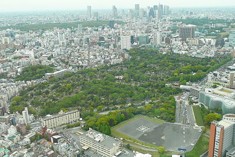
Aoyama Cemetery in central Tokyo taken from the Mori Building, Roppongi
(This is about half of the main “story”, Serious Stones. You can find it elsewhere on the Fine Line Press site if you wish to enjoy more lively writing about this interesting cemetery.)
Aoyama Reien, or Blue Mountain Cemetery is in Aoyama, central Tokyo. “Reien” means “spiritual garden”. It is full of huge monuments to remember the dead, markers of tombs containing urns of ashes. Some of the headstones are small and carved, others are real rocks and they are seriously huge, monumental even.
I used to be a gravedigger a long time ago with my old school friend, James. It was in the university summer holidays – we mainly cut the grass in the country graveyards, real grass; we made neat grounds, and occasionally we dug real graves, real bodies going in. We used to joke that it was a dead-end job. Actually we loved it, perhaps because there were no deadlines!
I have an affinity for cemeteries, possibly reminding me of the days of resting weary limbs against ancient Scottish headstones.
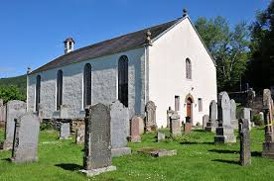
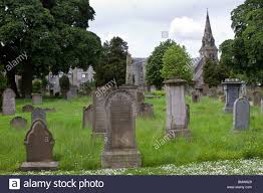
Little Dunkeld Kirk, Birnam, Perthshire.
Aoyama Cemetery is in central Tokyo, and the cemetery, or “reien” is full of headstones, memorials and storage for urns of ashes. A headstone is self-explanatory, it goes at the head. I suppose it would be a footstone if one revered the feet. Headstones in Aoyama Reien have no heads though, there’s nobody there … no body! Almost 100% of the dead in Japan are cremated. So everything in here is a commemoration of an urn of ashes. There are ashes at the base of the headstone. It should be noted though that the ashes have been carefully placed in the urn, bones and ash from the feet first up to the head. When I was a gravedigger, we were careful not to walk on the graves, knowing that there were real remains underneath. Here it’s no problem walking on the ground in front of a stone. Desecration or disrespect would be walking on the actual stones, or climbing them.
I lived in Tokyo for 20 years in the 1980s and ’90s, and went only a few times to Aoyama Reien. The first time was in 1983, when I started teaching English in Tokyo, must have been the end of March because my partner and I went there on a cherry blossom picnic. It’s possible that we were too busy teaching during the week, then at weekends we were too occupied with escaping the thrum and thrill of Tokyo by taking a train into the countryside or to the coast over an hour away. Aoyama is a residential area in central Tokyo, and the cemetery covers 65 acres – that would be about 50 times the area of the local graveyard here in Kerikeri, New Zealand where I now live. The value of the Tokyo real estate equivalent of Aoyama’s huge cemetery must be staggering. Anyway, we went to Aoyama Cemetery for a cherry blossom picnic – yes, a picnic in a cemetery. In the 20 years since leaving Tokyo, I have been back many times for short visits, and have walked in the cemetery on several occasions each visit, partly because my comfortable hotel is nearby. Returning to a foreign place you once lived and worked in can be like going home. For me Aoyama Reien is like a home within a home.
This ancient cherry-tree filled graveyard is an oasis of nature and monumental stones. I find wonderful the combination of trees and stones, the numerous headstones, some huge and natural, others modern and fit for purpose with special incense holders. The cemetery is surrounded by soaring apartment blocks, low-rise office buildings, restaurants and busy streets. There used to be a school right where you’d think graves should be, the students able to look out on to the graves. The graves are on three sides of the school, a walkway through the cemetery being the fourth side. The National Art Centre, a train station and a temple are nearby. Beyond those immediate surroundings, there is a busy main street, Aoyama Dori running down one side of the cemetery. There are also many fine parks, themselves places of peaceful nature, similar to Aoyama Cemetery but without headstones, incense and crisscrossing pathways.
Every cemetery has its own special atmosphere, be it big or small. Of course, most cemeteries have visitors to graves, but some have actual work being done as I’ve wandered, sometimes a grave being prepared, other times an artisan setting up a stone, or a group in black gathered round for the lowering of a box, or as in Aoyama Cemetery people placing incense or plastic flowers or tidying and cleaning a grave and headstone. In this cemetery I’ve often seen kind old women making a visit to feed the cemetery cats.
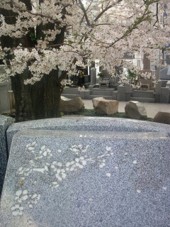
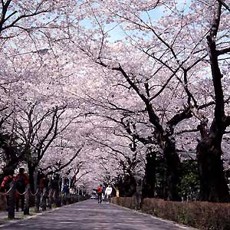
Cherry blossom above and below
Appropriately named Sakura Drive, the avenue through the middle of Aoyama Reien – sakura meaning cherry blossom, of course.
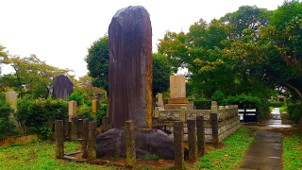
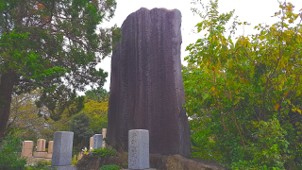
Huge stones in Aoyama Cemetery.
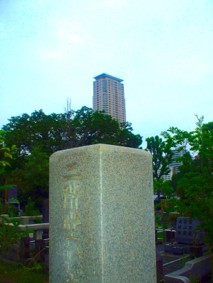
Bigger “stones” now surround the cemetery, looking down on the smaller stones looking up at their distant lookalikes or wannabe real stones. They’re in the nightlife area of Roppongi, overlooking the dead centre of Tokyo.
These are possibly wannabe stones overseeing the graveyard, or I should say “headstone yard”.
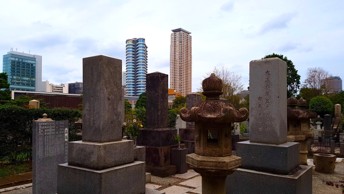
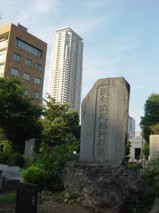
What’s it like up there? Down there?
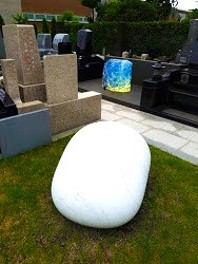
This egg-like stone is made of marble. I have no idea who would want a stone like this, the only one of its kind, a real standout. It is especially strange when we consider the reserved nature of Japanese people, marked by a general desire to conform to the group, not to differentiate or be annoyingly individual. And look at the glass marker in the background!
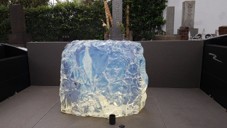
Perhaps a reflection of the deceased’s life or work? He was possibly a glazier?
Together in life and death!
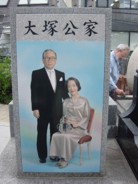
Now, here’s the ultimate in individuality, perhaps Japanese people trying to show if they can’t change and be a bit flamboyant in life, they can surely express themselves in death – no more worrying about what others think. I imagine this is a photo of the deceased couple, but the family must have had to wait to do this, they couldn’t both have demised together … unless … OK, let’s not go there, too lurid and over-imaginative. It’s not only Japan where such could easily be a possibility, I recall going to a double funeral in New Zealand, a public farewell, two boxes. I guess not much call for a double coffin. I wonder if they commingle loved ones’ ashes. Together in life, together in death!
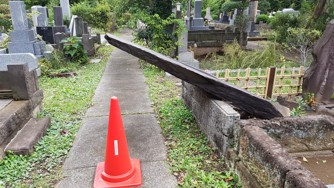
The cone warns walkers of this toppled stone. I hope anyone approaching from the other direction will be all right. I wonder how it happened, doubt if it was less than solid construction, not in Japan. Could have been one of Tokyo’s frequent earthquakes? I don’t think it’s meant to be like this, much too individual and taking up public space. And I am surely glad it’s not this stone!
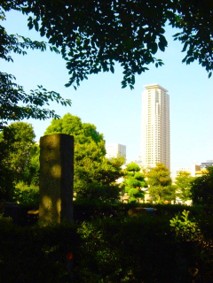
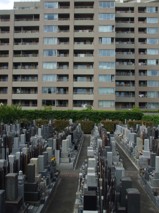
Rooms with views to
die for?
It’s sunnier out here,
up here. / I can see
you! / It’s cool in
this graveyard.
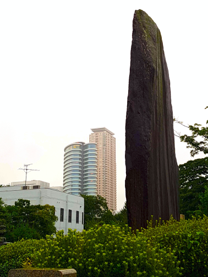
The weather’s better down here!
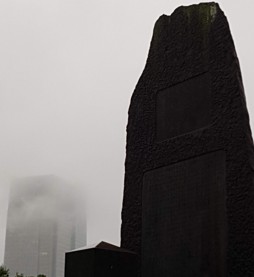
In the background the Ritz-Carlton A big one!
Hotel almost lost in a pre-typhoon mist.
If you want more information and photos of Aoyama Reien, I recommend you to visit the site “Stone and Dust”.